
Bambiraptor feinbergi — the 95% skeleton a fourteen-year-old found
A kid found this one.
In 1995 Wes Linster was fourteen, out fossil hunting with his family near Glacier National Park in Montana, and he turned up a small theropod that came out of the ground about 95% complete with the skull still on it. For a small dromaeosaurid that is close to unheard of. Most of what we know about animals this size is assembled from scraps — a claw here, three vertebrae there, a jaw fragment somebody argues about for twenty years. This one arrived nearly whole.
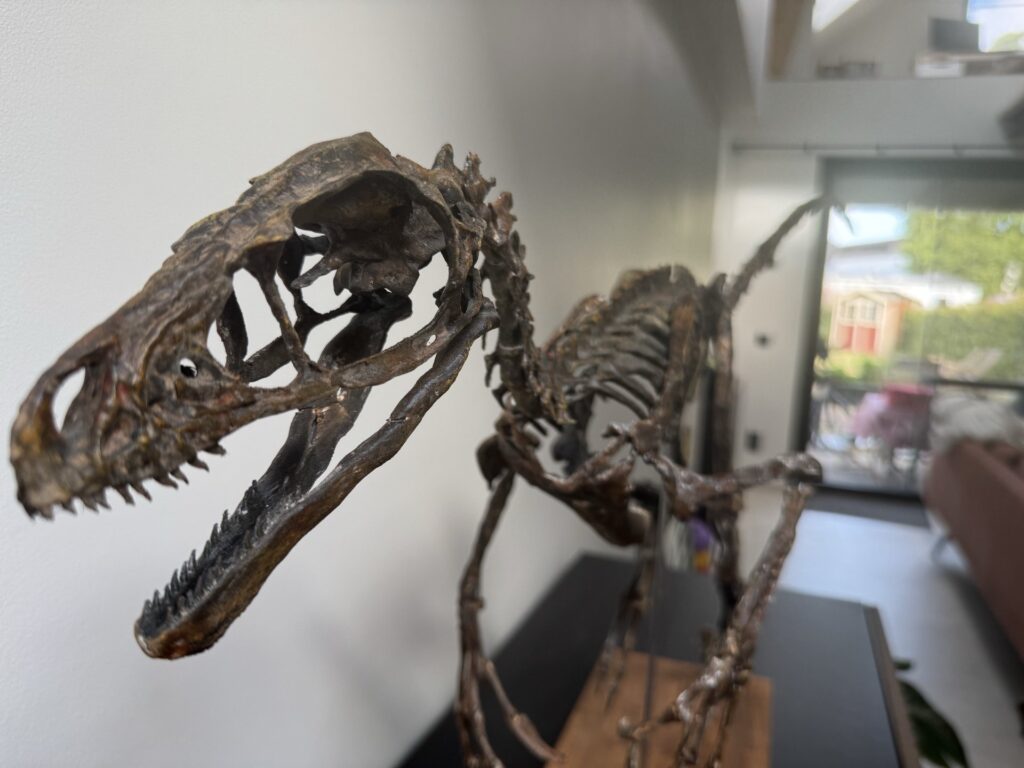
It came out of the upper Two Medicine Formation, late Campanian, so roughly 75 million years old. Burnham, Derstler, Currie, Bakker, Zhou and Ostrom described it in 2000. The holotype is AMNH FR 30556 and it lives at the American Museum of Natural History in New York.
The name is a joke that stuck. Bambiraptor because the animal is small and young. feinbergi for Michael and Ann Feinberg, who bought the fossil and handed it to science instead of putting it on a shelf at home — which, given how many important specimens end up in private collections, is worth naming a dinosaur over.
How I work: everything I sell is sculpted from scratch. I work from photographs and published papers — descriptions, measurements, figures — and build the bone by hand from those. What I sell is my reconstruction of an animal, not a scan or a cast of anyone’s specimen or anyone’s product.
The part people skip
The holotype is a juvenile.
That matters more than it sounds. The preserved skeleton is about 90 cm long, and life length was probably around a metre at maybe 2 kg. A grown Bambiraptor was likely closer to 1.3 m and 5 kg. So when you see “one metre” attached to this animal — including on my own model — you are looking at a young one, not the adult.
I’d rather say that up front than let someone print it, put it on a shelf, and later find out they’ve got a teenager labelled as a species.
Hands that could reach its own mouth
The forelimbs are the interesting bit. The hand had unusual mobility for a theropod: the first and third fingers work against each other to a degree, and the arm could fold far enough to bring the hand to the mouth. That’s a grasping animal — something closer to handling food than just running it down.
The braincase gets quoted a lot too. At around 14 cm³ it was, when described, the largest brain relative to body size of any dinosaur known. True, and I’d add one caution nobody adds: this is a juvenile, and young animals carry proportionally larger brains than adults do, because brains finish growing before bodies do. So the ratio is real, and it is also flattered by the animal’s age.
About the feathers
No feathers are preserved with this specimen.
Everyone draws it feathered anyway, and I think that’s right — its close relatives do preserve feathers, and the anatomy sits squarely inside the group where feathers are the default assumption rather than the exception. But there’s a difference between “the fossil shows this” and “the family it belongs to shows this”, and a skeletal reconstruction is exactly the place to keep those apart.
The skeleton itself doesn’t tell you what colour the animal was either, and nobody selling you a dinosaur should pretend otherwise.
What isn’t there
The right side of the skeleton is damaged, and the end of the tail is missing. So even at 95% complete, some of what you’re looking at on any mount is mirrored from the good side or reconstructed from related animals. That’s normal. It’s still worth saying which is which.
There’s a timelapse of the skull being sculpted here: Timelapse: Sculpting the Bambiraptor Skull
References
Burnham, D.A., Derstler, K.L., Currie, P.J., Bakker, R.T., Zhou, Z. & Ostrom, J.H. (2000). Remarkable new birdlike dinosaur (Theropoda: Maniraptora) from the Upper Cretaceous of Montana. University of Kansas Paleontological Contributions, new series 13.
American Museum of Natural History — Bambiraptor.
Paul, G.S. (2010). The Princeton Field Guide to Dinosaurs. Princeton University Press — adult size estimate.

