
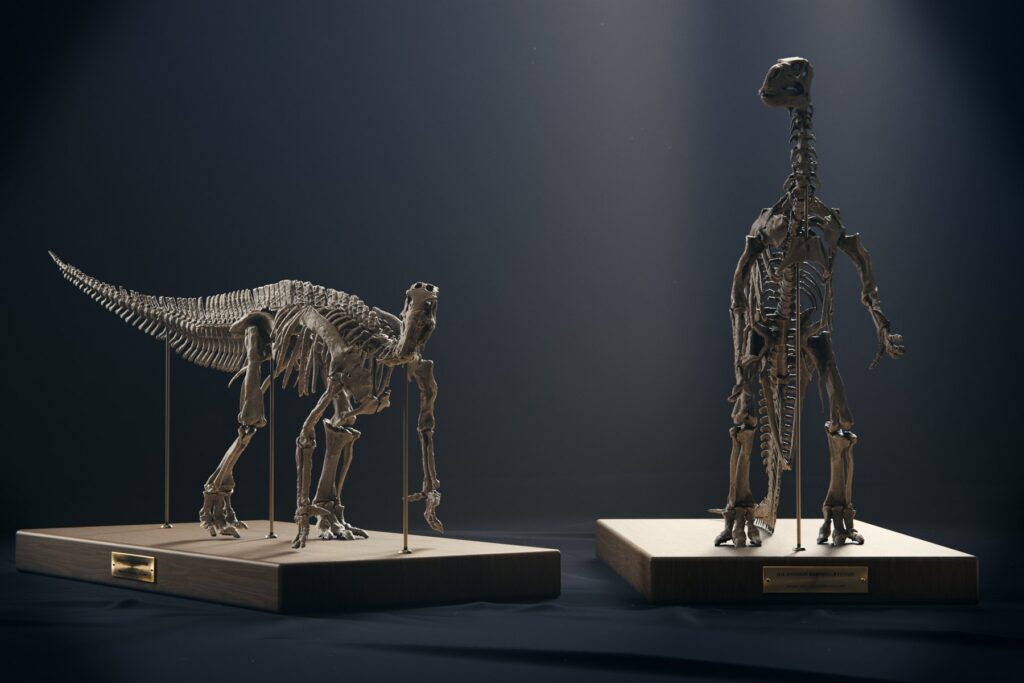
The Bernissart Iguanodons: dinosaurs from a Belgian coal mine
At the end of March 1878, miners in the Sainte-Barbe pit at Bernissart were working 322 metres down when they ran into a pocket of clay. They didn’t go around it. They went straight through, and a few days later they were telling people they’d found tree trunks full of gold.
It wasn’t gold. It was pyrite, fool’s gold, and the tree trunks were bones. Iguanodon bones. That clay pocket ended up giving around thirty fairly complete skeletons, and you can still see them in Brussels, a short train ride from my workshop in Aalst.
I sculpted this animal twice, once the way it was mounted in 1882 and once the way it’s understood today. Here’s the story behind both, and what to look for if you go and see the real ones.
A telegram, 600 blocks and 130 tons of fossil
On 12 April 1878 the museum in Brussels got a telegram from the mine. Big find of bones in a fault, the pyrite is falling apart, send De Pauw, he’ll be picked up at Mons station at eight tomorrow morning. Louis De Pauw was the museum’s preparator, and getting those animals out of the ground became his job.
Every skeleton was cut into blocks between half a metre and two metres across. Each block was coated in plaster, numbered, and its position in the mine written down, so the animals could be put back together later. Almost 600 blocks. It took 37 cartloads to get the 130 tons of bone, plaster and iron frames to Brussels.
The pyrite was the real problem. It had filled every hole in the bones. In the museum lab the technicians cleaned out what they could, dipped the bones in boiling glue to hold them together and wrapped them in tin foil to keep the damp out.
Why they stand like kangaroos
In 1882 Louis Dollo, the palaeontologist who studied the Bernissart animals, had De Pauw start mounting the most complete skeletons in what Dollo believed was their natural pose. They needed a high ceiling for that, so they used the St George chapel in Brussels, hung the bones from a scaffold on ropes and lengthened or shortened each rope until the bone sat right.
Dollo was convinced Iguanodon walked on two legs. The backbone looked like a biped’s to him, the hips and legs reminded him of an ostrich or a cassowary, and a fossil trackway from England seemed to show it walking upright. So up it went, on its hind legs, with the tail on the ground.
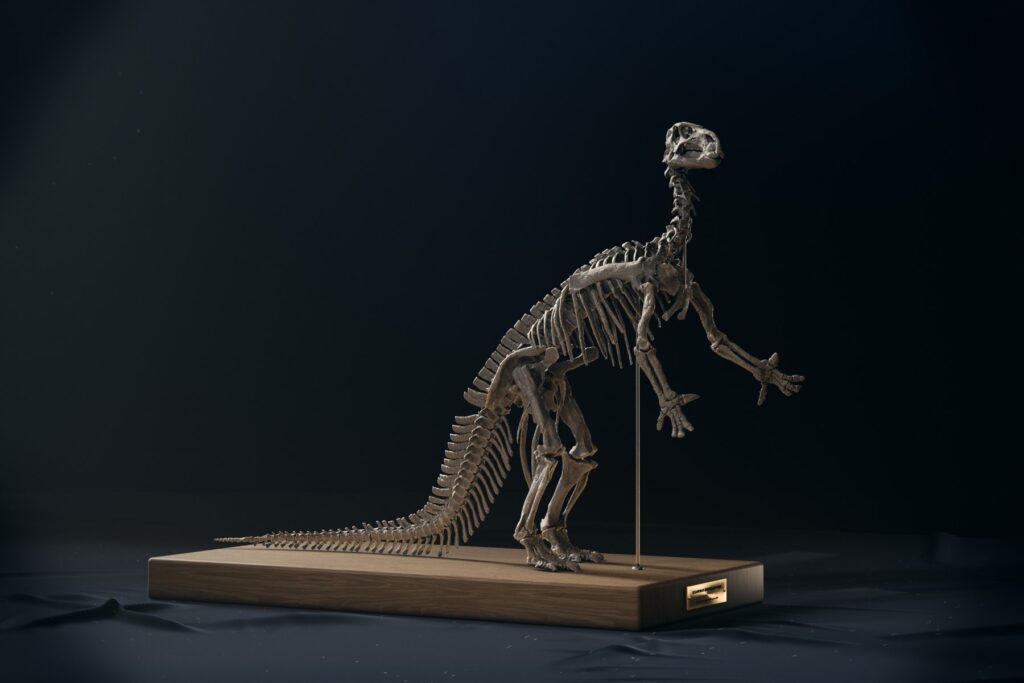
The first one went on show in 1883, in a glass case in the courtyard of the old Palace of Nassau. For most of the next hundred years, that upright animal is what an Iguanodon looked like.
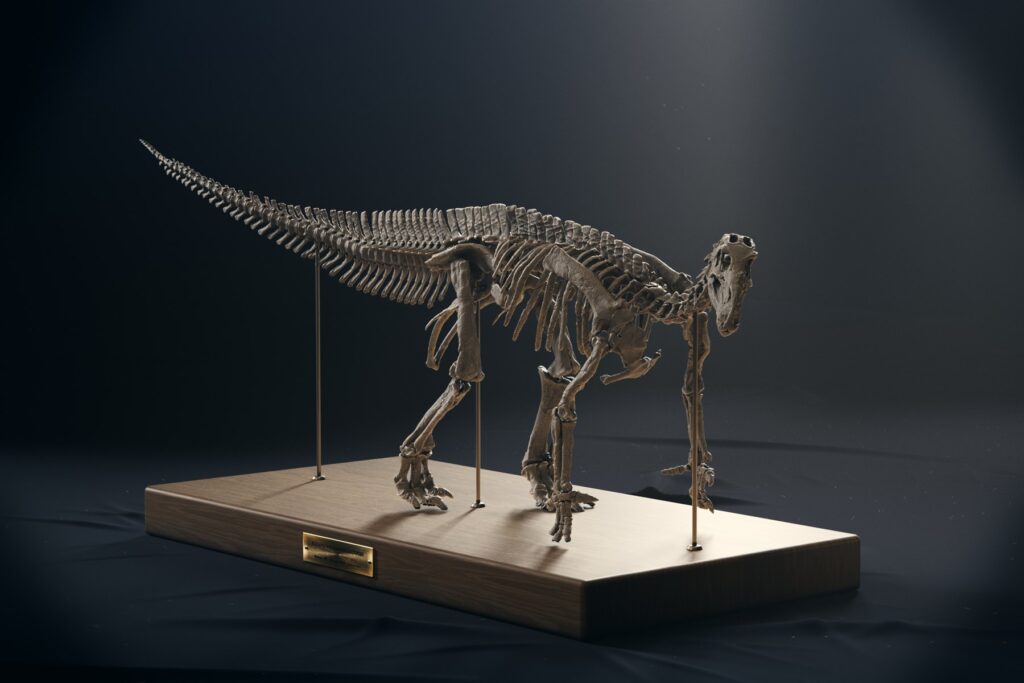
It was wrong, and the skeleton itself gives it away. To get the tail onto the ground in that pose it had to be broken. In 1980 David Norman published his big monograph on the Bernissart skeletons and found a very different animal, with the back held more or less level and spending much of its time on all fours. The hands back that up. The three middle fingers are bound together so tightly they work like a hoof.
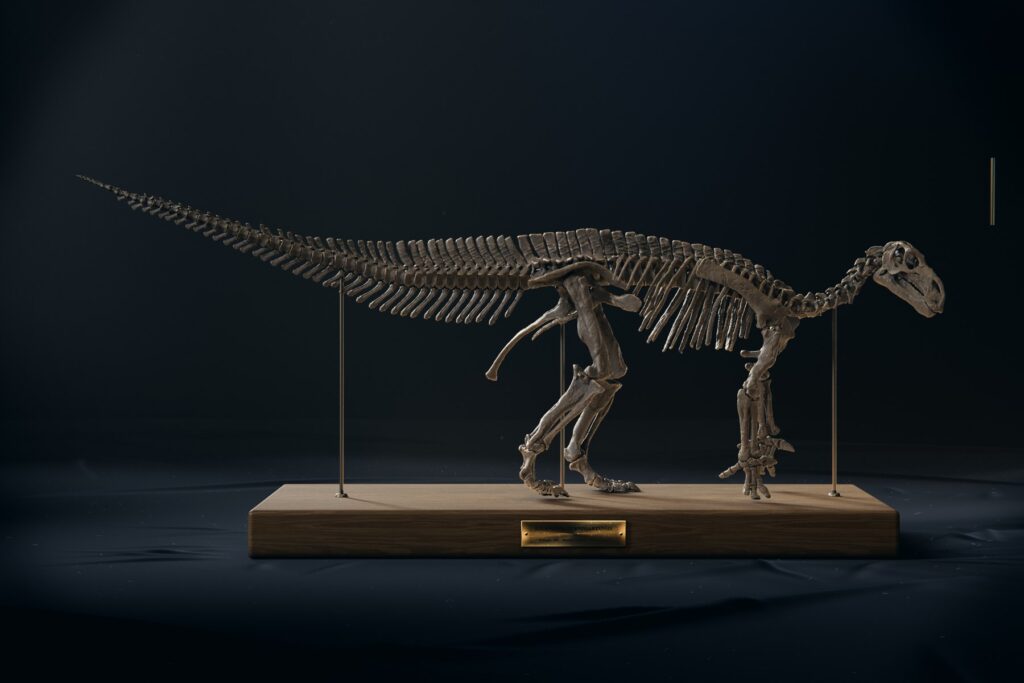
The museum has left the old mounts as they are. The skeletons are too fragile to take apart and pose again, and honestly I’m glad. At this point they’re a piece of history in their own right.
They’re brown because of shellac, not coal
Most people assume the colour comes from the coal mine. It doesn’t. The skeletons stood out in the open air of the museum until 1932, and the swings in temperature and moisture slowly started to crumble them. Between 1933 and 1937 every one of them was taken apart and soaked in a mix of alcohol and shellac. That’s the brown you see.
They came down once more in 1940, because of the fear of bombing, and went into cellars that turned out to be so damp the skeletons had to be brought back up before the war was over.
What to look for when you go
The Iguanodons stand in a 300 m² glass case in the Dinosaur Gallery, which the museum calls the largest dinosaur hall in Europe. Eight of them are Iguanodon bernissartensis, between 6.3 and 7.3 metres long. Then there’s one much smaller animal, 3.9 metres, that used to be called Iguanodon mantelli and is now Mantellisaurus atherfieldensis. Stand at the end of the row and you’ll see how much the size varies between them.
Look at the hands. The thumb is a big conical spike sticking out of the wrist. The three middle fingers are locked together for walking on, and the little finger is long and flexible enough to grab with. That’s three different jobs on one hand. And don’t skip the basement, where some of the skeletons are laid out the way they were found in the mine.
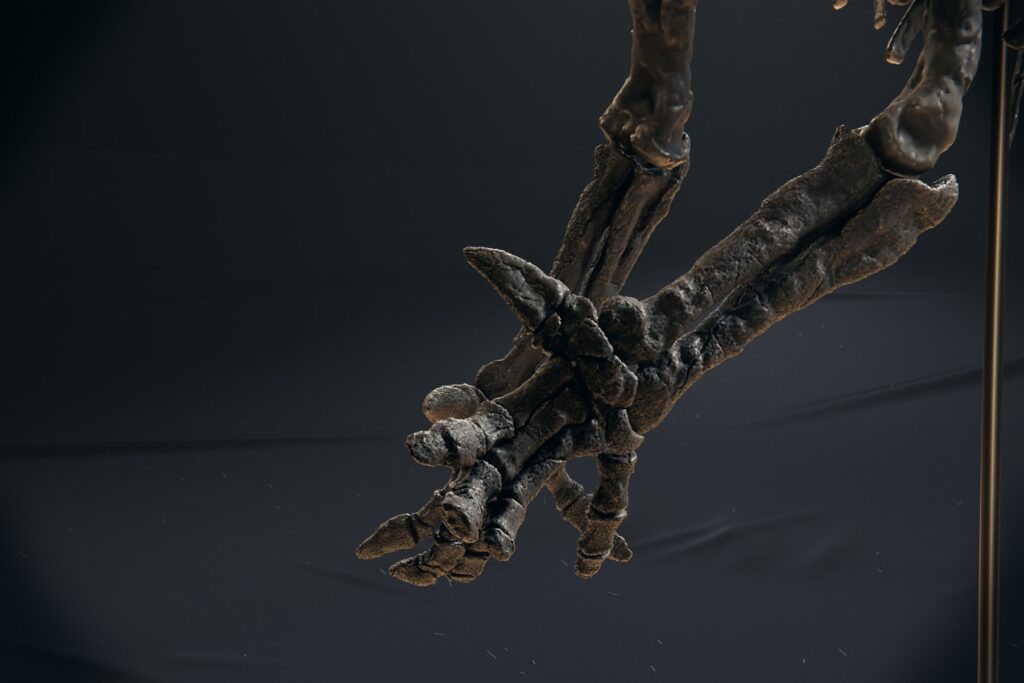
I went back to that glass case several times while I was building mine, mostly to check proportions and how the bones sit against each other. If you read French, Pascal Godefroit’s book Les Iguanodons de Bernissart. Des fossiles et des hommes is in the museum shop, and it’s the most complete thing written about them.
The museum is the Institute of Natural Sciences, Rue Vautier 29, 1000 Brussels. It’s closed on Mondays, open from 9:30 to 17:00 Tuesday to Friday and from 10:00 to 18:00 at the weekend, but check opening times and tickets on their website before you go. Their own page on the skeletons is here: The Bernissart Iguanodons.
Both poses, for your own shelf
When I sculpted my Iguanodon I couldn’t choose between the two, so I made both. The modern mount stands on all fours and measures about 900 mm from snout to tail tip. The 1882 mount stands upright with its tail on the base, about 490 mm tall. I built them from Norman’s monograph and from what I saw in that glass case. Put them next to each other and you’ve got almost 150 years of science on one shelf.
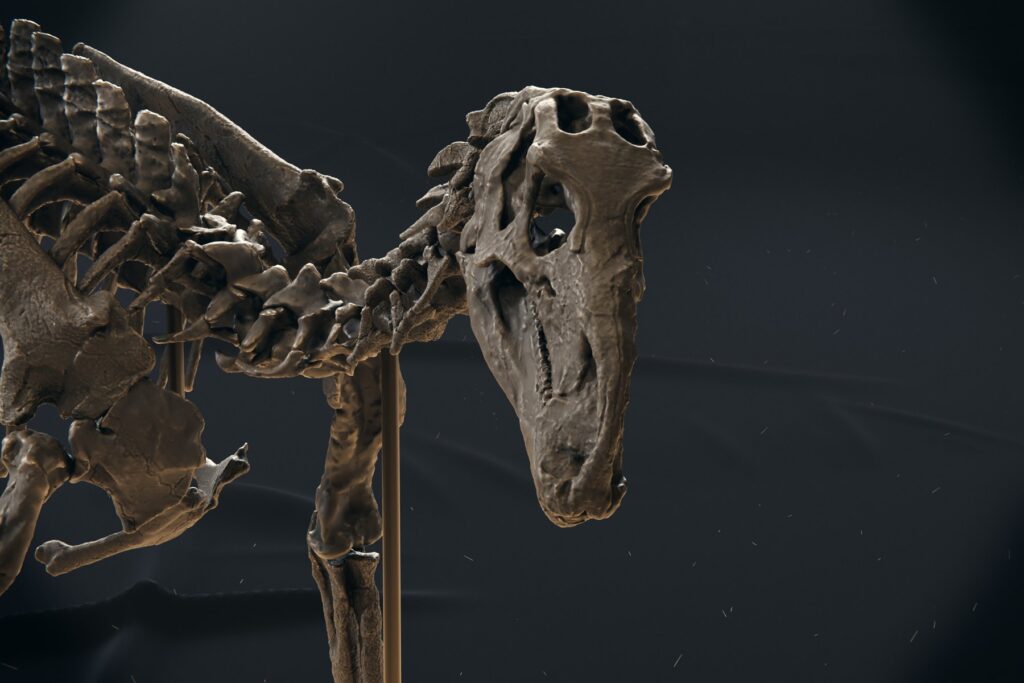
The kit is 25 STL parts with the holes for 4 mm steel rod already in them, plus a 36-page manual with a render for every step. You’ll find it in the shop here: Iguanodon skeleton STL.
References
Norman, D.B. 1980. On the ornithischian dinosaur Iguanodon bernissartensis from the Lower Cretaceous of Bernissart (Belgium). Mémoires de l’Institut royal des Sciences naturelles de Belgique 178.
Institute of Natural Sciences. The Bernissart Iguanodons at a glance.

