
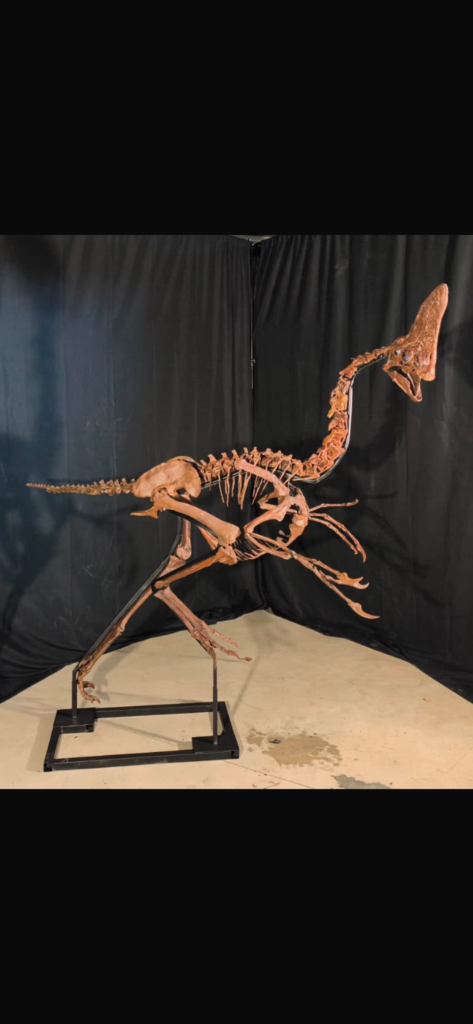
Spike: the caenagnathid you’ll never see in a museum
One of the most complete dinosaurs of its kind ever found. You’ll never see it in a museum.
Meet Spike, a caenagnathid: one of those feathered, beaked, bird-like dinosaurs, and one of the most complete ever pulled from the ground. Around 68 million years old, dug up in 2022, possibly a species science hadn’t even named yet.
Then in December, Christie’s sold him for £3.46 million and he disappeared into a private collection. “The most complete caenagnathid known in private hands” was the selling point, as if that were something to be proud of.
What a caenagnathid actually is
Caenagnathids sit in a group called the oviraptorosaurs: feathered, toothless, beaked dinosaurs from the end of the Cretaceous, closer to living birds than to the big fanged theropods most people picture when they hear “dinosaur.” Most of them are known from almost nothing. A lower jaw here, a foot there, a handful of vertebrae. Palaeontologists have argued for decades over which scraps belong to which animal. That’s what makes a nearly complete one extraordinary, and it’s exactly why where this skeleton ended up matters so much. A specimen like that can settle arguments that fragments never could. It can’t do any of that in a hallway.
How do you rebuild a skeleton you’re not allowed to study?
The honest answer is: with difficulty. A specimen in a private collection is one I can’t put on a bench, can’t measure, can’t take apart and photograph from every side. So I work from every image of it I can find, and I fill in what those don’t show from its close relatives, the other caenagnathids and oviraptorosaurs that are still in public hands. Part of the mount is hard evidence and part is careful inference, and I try to stay honest about which is which. That gap is the whole problem. When a fossil vanishes into a collection, the open questions stay open, because nobody can go back to the bones to check.
Why a life-size 3D printed dinosaur skeleton
I didn’t build my Spike from a museum specimen, because there isn’t one. I built him because I’m tired of watching this happen: history that belongs to all of us, dug out of the ground and sold to the highest bidder before science ever gets its turn. A skeleton like that should be teaching people somewhere everyone can reach it, not decorating a hallway.
So I sculpted him and had Theropodia build him in France as a life-size, 3D printed dinosaur skeleton you can stand next to. It’s the same reason museums print my files on their own machines: the anatomy travels as a file, so it can be in more than one place at once, instead of locked behind one collector’s door.
If it can’t stay where it belongs, I’ll at least keep its shape and its story out here where you can see it.

