
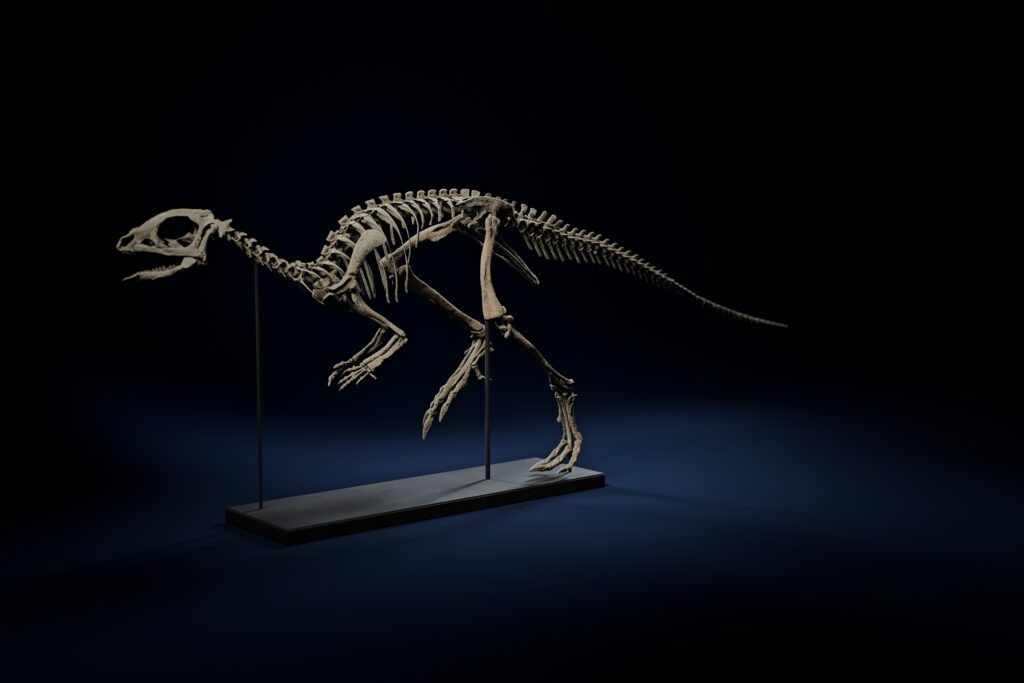
Jeholosaurus: the dinosaur we only know as a kid
Every Jeholosaurus anyone has ever dug up was young. The type specimen, the second skull, the four specimens described in 2009, the little skull that got CT-scanned last year: all juveniles or subadults. Nobody has found a grown-up one. So when I built a life-size Jeholosaurus skeleton, life-size meant the size of a teenager, and I still don’t know how big the adults got. Neither does anyone else.
Here’s what we do know about it, and how mine came together.
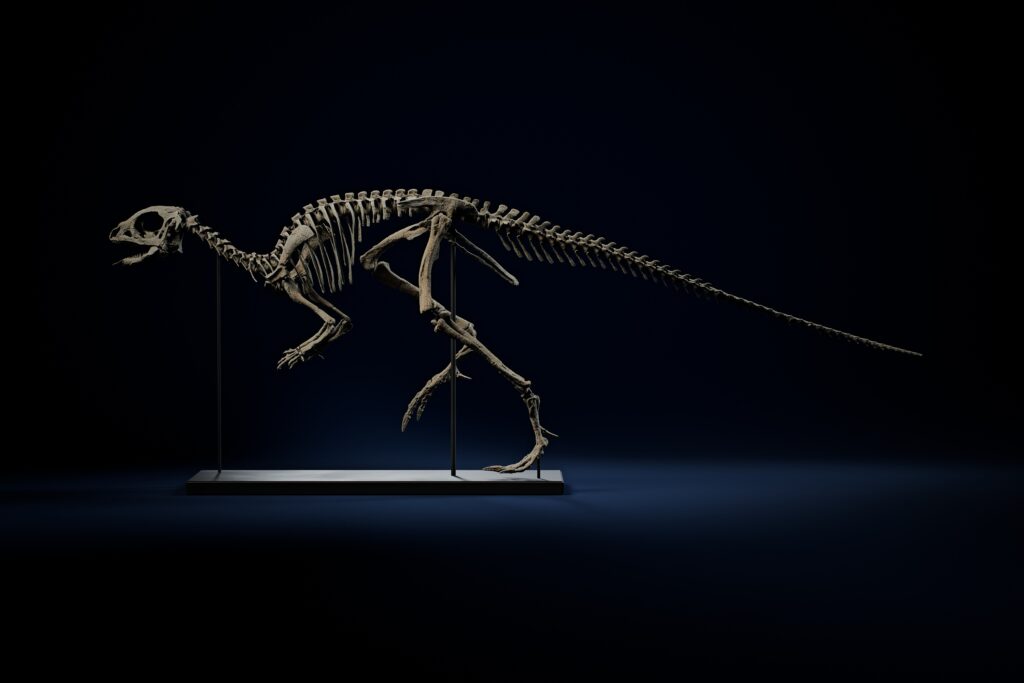
A small plant-eater from a volcanic graveyard
Jeholosaurus shangyuanensis was named in 2000 by Xu Xing, Wang Xiaolin and You Hailu. Jehol is the old name of a province that covered western Liaoning and a slice of Hebei, and Shangyuan is the area the fossils came from, near the village of Lujiatun.
The rocks at Lujiatun are the bottom of the Yixian Formation, around 125 million years old, and they’re volcanic. Ash came down, water washed it around, and whatever got caught in it was buried fast and whole. That’s why this one place keeps turning up complete skeletons. Psittacosaurus in groups. The little troodontid Mei long, curled up with its head tucked under its arm like a sleeping bird. Changmiania, two small plant-eaters that may have died in their own burrow. Jeholosaurus was walking around in the middle of all that.
Mostly a vegetarian. Probably.
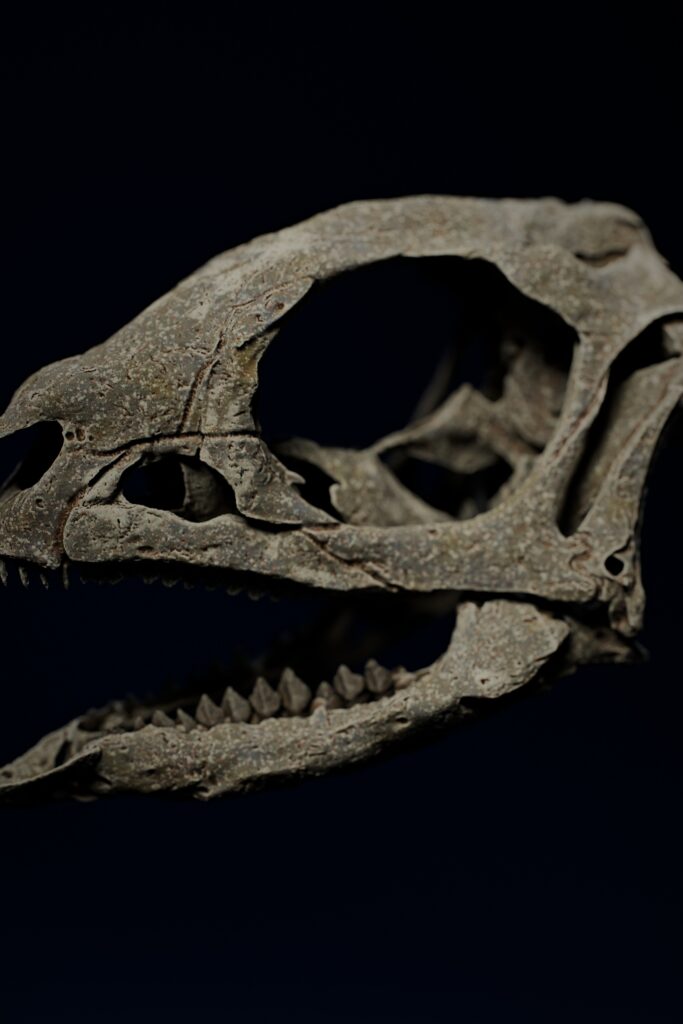
On paper Jeholosaurus is a small two-legged herbivore. The teeth tell a slightly messier story. At the very front of the upper jaw there are six teeth that are conical and a bit curved, the kind you’d use to grab rather than chew. Further back, the cheek teeth are leaf-shaped, which is the textbook plant-eater design.
That mix is why you’ll often see it called a possible omnivore. It may have eaten insects or small animals as well as plants. Or not. Diet is one of those things we mostly work out from teeth and jaws, and teeth like these leave room for both answers.
The holotype is a teenager
The type specimen, IVPP V12529, is kept at the Institute of Vertebrate Paleontology and Paleoanthropology in Beijing. It’s a flattened skull, the first seven neck vertebrae, broken pieces of the back and hips, stretches of tail and both hind legs. You can tell it’s young from the backbone: the neural arches, the upper half of each vertebra, hadn’t fused to the vertebral bodies yet. In an adult they would have.
Measured from snout to tail tip it comes to about 71 cm, and almost half of that is tail. My skeleton ends up at 72 cm on its base, which is close enough that I’m happy with it.
Nobody agrees where it sits in the family tree
In 2012 Han Fenglu and colleagues described the rest of the skeleton in detail and put Jeholosaurus in a family of its own, Jeholosauridae, together with Changchunsaurus from Jilin and Haya from Mongolia. Their analysis placed the group near the base of the ornithopods, the early end of the line that eventually leads to Iguanodon and the duck-billed dinosaurs.
Since then it has moved around with almost every new analysis. Some put the jeholosaurids just inside Ornithopoda, some just outside. I wouldn’t bet money on where it ends up.
A proper look inside the skull
The most useful thing to happen to Jeholosaurus in years was published in January 2025. Filippo Bertozzo, Niu Kecheng, Nathan Vallée Gillette and Pascal Godefroit CT-scanned a small, very well preserved juvenile skull, YLSNHM 01942, from the Yingliang Stone Natural History Museum in China. The whole skull is 5.9 cm long.
They segmented every bone out of the scan, including parts of the braincase that had never been described for this species, and rebuilt the inner ear. Two details I liked. This skull has none of the little bumps you see on the bones around the eye in older Jeholosaurus, so that ornament seems to come with age. And there’s a short gap with no teeth in the upper jaw, about one or two teeth wide.
Then they did something that doesn’t happen nearly often enough: they put all the 3D models online for free, under a CC BY 4.0 licence. For someone who builds skeletons for a living, that’s gold.
How I built mine
The skull on my skeleton is sculpted on those published CT models. I used them as the starting point and worked over them until the end result was my own sculpt, then opened the jaw and fitted the head to the neck. Everything behind the skull I sculpted myself, from Han and colleagues’ 2012 description.
When it was finished I sent the skeleton and its measurements to Filippo. He went through it and gave me advice along the way. Having the person who studied that skull check the finished animal is about the best review I could have asked for, and it’s the main reason I think this is the most accurate Jeholosaurus you can print right now.
The print
It’s life-size at the holotype’s size: 72 cm from snout to tail and 26 cm tall on the base, mid-stride with the left foot coming down. You get 16 STL files, fifteen skeleton parts plus the base with its three posts. The seams sit where bones meet anyway, the pin holes are already in the model, and a 16-page manual walks you through the build. The bones want a resin printer; the base needs a large-format one.
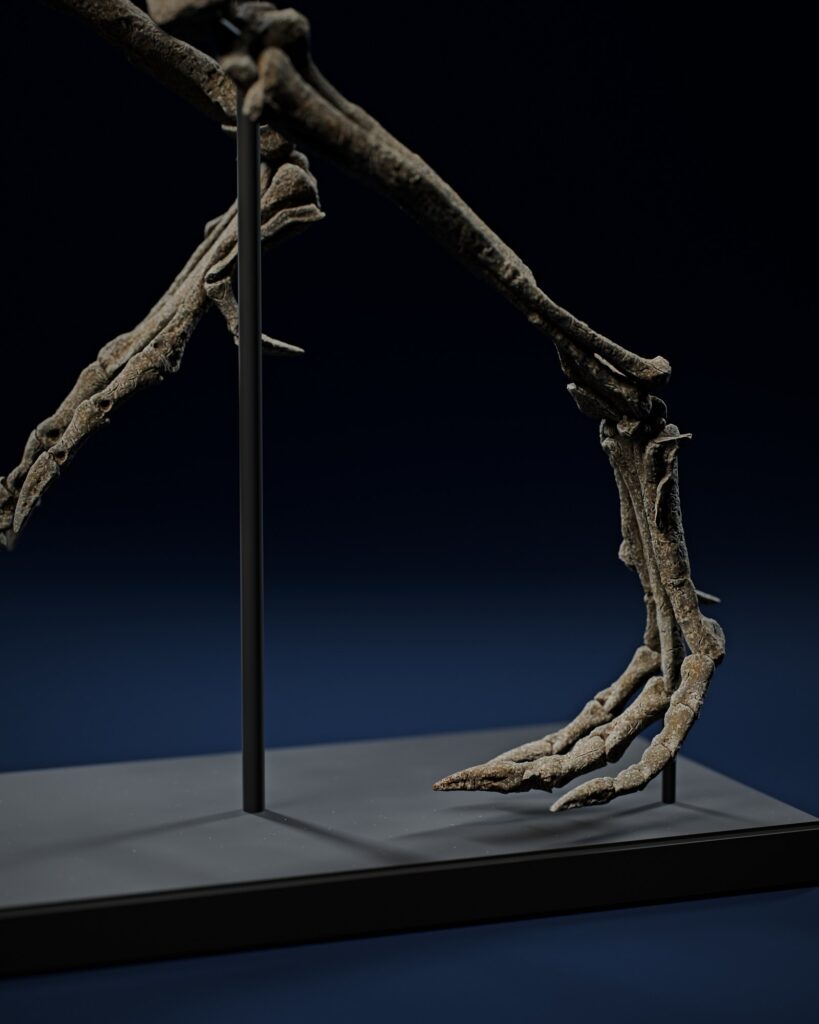
If you want one, it’s in the shop: Jeholosaurus skeleton STL. And if anybody ever digs up an adult, I’ll be first in line to build that one too.
References
Xu, X., Wang, X.-L. & You, H.-L. 2000. A primitive ornithopod from the Early Cretaceous Yixian Formation of China. Vertebrata PalAsiatica 38(4): 318–325.
Barrett, P.M. & Han, F.-L. 2009. Cranial anatomy of Jeholosaurus shangyuanensis (Dinosauria: Ornithischia) from the Early Cretaceous of China. Zootaxa 2072: 31–55.
Han, F.-L., Barrett, P.M., Butler, R.J. & Xu, X. 2012. Postcranial anatomy of Jeholosaurus shangyuanensis (Dinosauria, Ornithischia) from the Lower Cretaceous Yixian Formation of China. Journal of Vertebrate Paleontology 32(6): 1370–1395.
Bertozzo, F., Niu, K., Vallée Gillette, N. & Godefroit, P. 2025. Anatomical description and digital reconstruction of the skull of Jeholosaurus shangyuanensis (Dinosauria, Ornithopoda) from China. PLOS ONE 20(1): e0312519. doi:10.1371/journal.pone.0312519

