
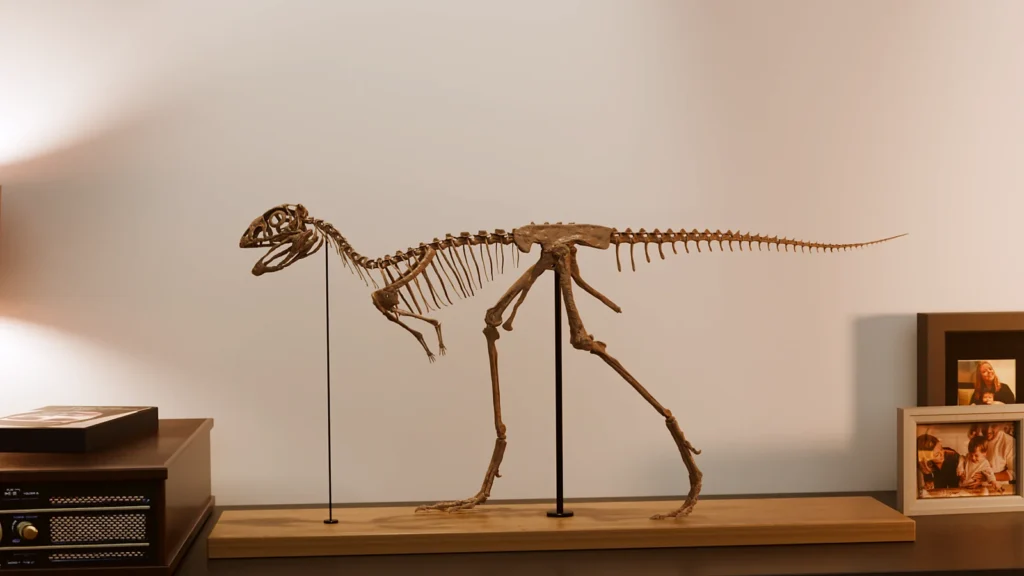
Berthasaura leopoldinae: the ceratosaur that lost its teeth
Most of the animals I sculpt are known from scraps. A jaw, three vertebrae, half a foot, and twenty years of argument about where the rest went. This one is different, and that is the only reason I picked it.
Berthasaura leopoldinae came out of a quarry in Paraná, in southern Brazil, that the people digging there call the Cemitério dos Pterossauros. The Pterosaur Cemetery. The name is earned: the site is a dense bonebed of pterosaurs, and between 2011 and 2015 it gave up hundreds of their bones. Somewhere in that pile was a small theropod with nothing in its jaws.
The teeth were there, and then they weren’t
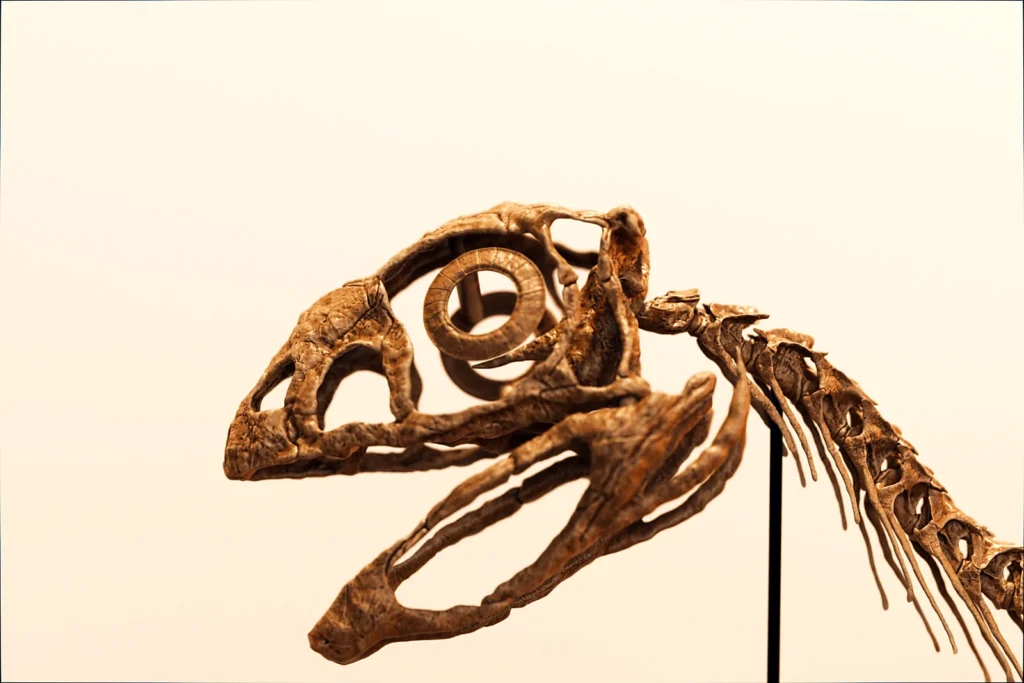
The holotype, MN 7821-V, is a nearly complete skeleton with a partial skull and lower jaw. It was described in 2021 by de Souza and colleagues, and the headline was the mouth: a ceratosaur with no teeth at all. In a group where essentially everyone else is a predator, that is a strange thing to find.
The 2021 team looked at the dentary, saw no clear tooth sockets, and concluded this animal may never have had teeth in the first place. Which would have made it different from Limusaurus, the Chinese ceratosaur that is known to hatch with teeth and shed them as it grows.
That reading has since changed. In 2025 Pierossi and colleagues went back to the same dentary and found vestiges of the alveoli — the sockets are there, filled in and remodelled, but there. So Berthasaura did the Limusaurus thing after all. It hatched with teeth and lost them growing up.
I like this kind of correction. Four years, same bone, better look, opposite answer. If you buy the model from me today you are buying the 2025 reading of that jaw, and if somebody overturns it again in 2029 I will change the page.
A ceratosaur that was probably eating plants
What replaced the teeth was almost certainly a beak. The pattern of neurovascular foramina along the jaw margins is the sort you get under a keratinous sheath, and the front of the upper jaw carries a cutting edge rather than a tooth row.
Put that together with the environment — the Goio-Erê Formation is a sandy, arid setting — and the 2025 study’s argument is that this animal was cropping the tough parts of desert plants. The same paper points out how much the lower jaw resembles an oviraptorid’s: deep from top to bottom, with a large opening in the side. Two lineages of theropod, on different continents, no close relationship, arriving at the same jaw because they were doing the same job with it.
So: a herbivore, or at minimum an omnivore, sitting inside a family tree of meat-eaters.
It has its own family now
When it was described, Berthasaura was put in Noasauridae. In 2024 Hendrickx and colleagues, working mainly on Noasaurus itself, ran the numbers again and moved it out into a family of its own — Berthasauridae, sitting just outside the abelisauroids.
I mention this because it will date. Small theropods from South America get reshuffled every few years and this one has been reshuffled twice in four years. The bones don’t move. The labels do.
What isn’t there
Here is what the fossil actually is, because I would rather you knew.
The skull is partial and the whole skeleton came out of the ground disarticulated. The vertebral column is good — the axis, four cervicals, eleven trunk vertebrae, five sacrals — but the tail is sixteen vertebrae from different parts of the series, not a continuous run, so the exact length of the tail is an estimate. Of the limbs, the left arm is there and the right one isn’t. No right humerus, no right radius or ulna, no right femur, and the right tibia is a fragment. The distal end of the tibia with the astragalus and calcaneum is gone as well.
So one side of this animal is reconstruction. On a bilaterally symmetrical animal that is a defensible way to work, and it is what everyone in this field does, but I would rather say it out loud than let you assume every bone in the file came out of a quarry.
Where the fossil ran out I worked from its closest relatives, and the nearest one in every sense is Vespersaurus paranaensis. It comes out of the same beds at Cruzeiro do Oeste, it was described in 2019, and it is close enough in build to be genuinely useful.
Not for everything, though. Vespersaurus has one of the strangest feet in the group: the second and fourth metatarsals are squeezed flat side to side and the animal appears to have walked on a single central toe, which nobody had recorded in an archosaur before. So it is a good guide for much of this skeleton and a bad guide for the foot. That is what this work mostly consists of — knowing which relative to trust for which bone, and where to stop trusting it.
The other thing is age. The specimen is a subadult, about a metre long, with skull and vertebral elements still unfused. No adult Berthasaura has ever been found. So when I say this model is life size, I mean life size for that individual — a young one. Nobody currently knows how big a grown one got, and anyone who gives you a number is guessing.
Building it at 1:1
The finished skeleton is 870 mm from snout to tail tip and stands 386 mm above the base. It prints as nineteen parts across seven folders — skull, neck, ribcage, forelimbs, pelvis, hindlimbs, tail — and the largest single part is the right foot at 186 mm long, which is what decides whether it fits your printer.
The mount follows museum practice rather than model-kit practice. One 8 mm steel rod runs up through the pelvis and carries the animal. A second, thinner rod at 2.5 mm goes to the skull.
That second rod is the part people ask about. It is there because the neck of this animal is slender and the head is not weightless, and if you hang the skull off the last cervical joint the glue line is doing structural work it was never meant to do. Give the head its own support and the neck joint only has to look right.
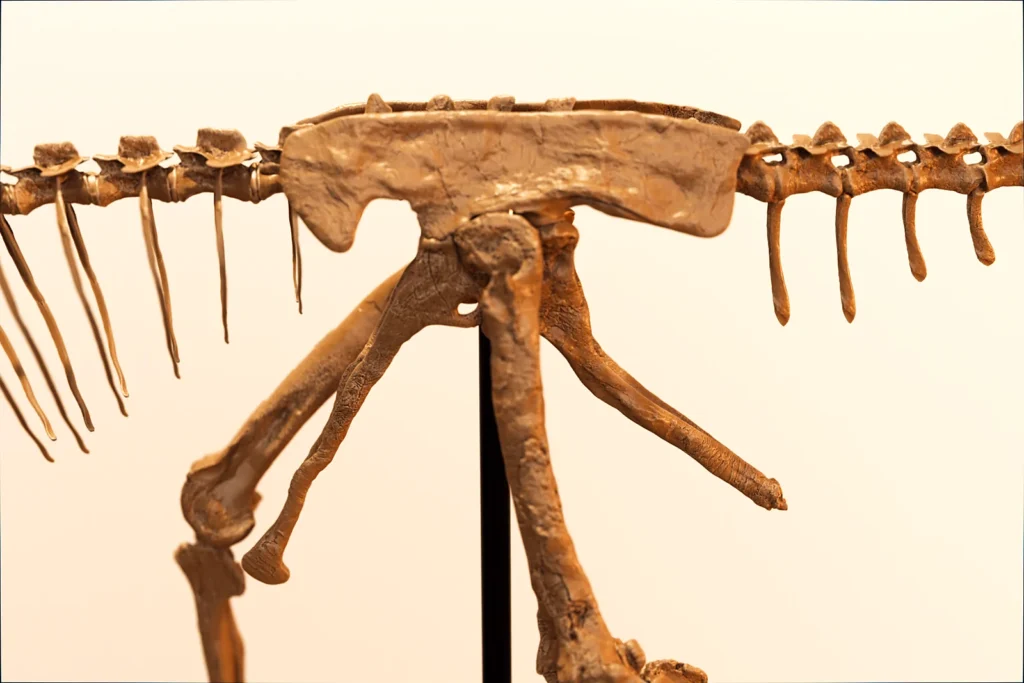
Ribs are thin, the neural spines are slender and the claws are about a millimetre across, so this one rewards a slow print and punishes a fast one. There is a full printing guide on the product page.
Berthasaura leopoldinae — complete skeleton STL
References
Langer, M.C., Martins, N.O., Manzig, P.C., Ferreira, G.S., Marsola, J.C.A., Fortes, E., Lima, R., Sant’ana, L.C.F., Vidal, L.S., Lorençato, R.H.S. & Ezcurra, M.D. 2019. A new desert-dwelling dinosaur (Theropoda, Noasaurinae) from the Cretaceous of south Brazil. Scientific Reports 9: 9379.
de Souza, G.A., Soares, M.B., Weinschütz, L.C., Wilner, E., Lopes, R.T., de Araújo, O.M. & Kellner, A.W.A. 2021. The first edentulous ceratosaur from South America. Scientific Reports 11: 22281.
Hendrickx, C., Cerroni, M.A., Agnolín, F.L., Catalano, S., Ribeiro, C.F. & Delcourt, R. 2024. Osteology, relationship and feeding ecology of the theropod dinosaur Noasaurus leali. Zoological Journal of the Linnean Society 202(4): zlae150.
Pierossi, F.F., Delcourt, R., Casali, D.M., Leme, J.A., de Oliveira Martins, N., Manzig, P. & Langer, M.C. 2025. Convergent evolution among non-carnivorous, desert-dwelling theropods as revealed by the dentary of the noasaurid Berthasaura leopoldinae (Cretaceous of Brazil). Palaeontology 68(4): e70014.

