
- About Berthasaura
- What’s in the download
- Printer size you need
- Printing this dinosaur skeleton STL
- Assembly
- Licence
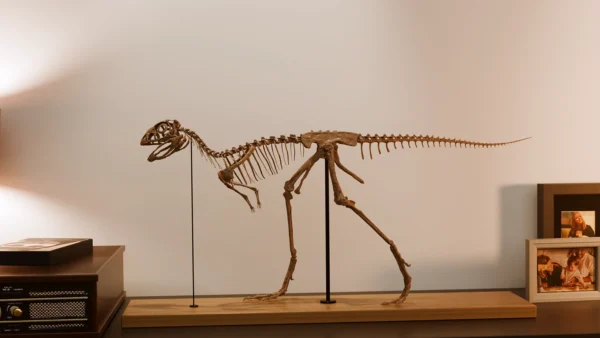
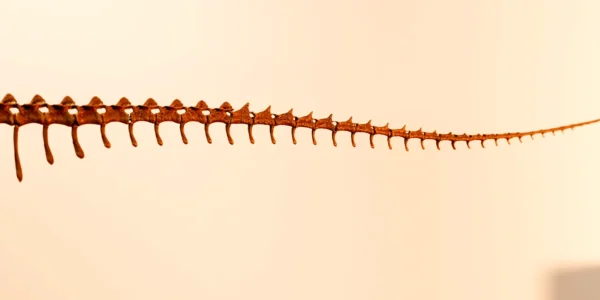
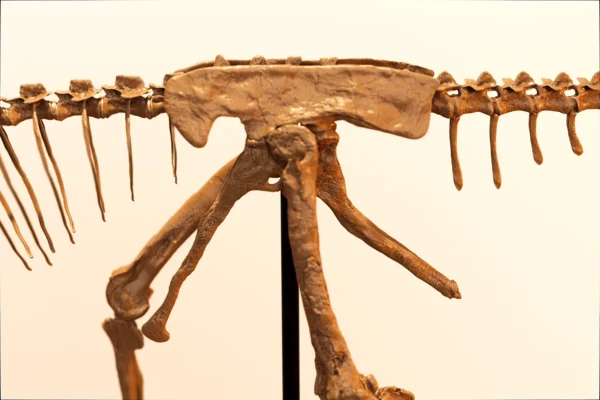
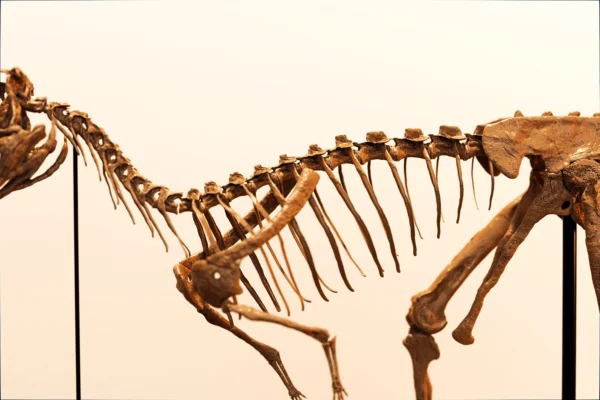
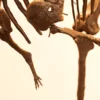
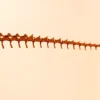
This dinosaur skeleton STL is a life-size reconstruction of Berthasaura leopoldinae, described in 2021 from a nearly complete skeleton found at the Cemitério dos Pterossauros site near Cruzeiro do Oeste, in Paraná, Brazil. The specimen, MN 7821-V, is a subadult and preserves the most complete axial series of any noasaurid found so far. That is unusual for this group, and it is the reason I chose this animal: there was enough real material to work from that I did not have to invent a spine.
About Berthasaura
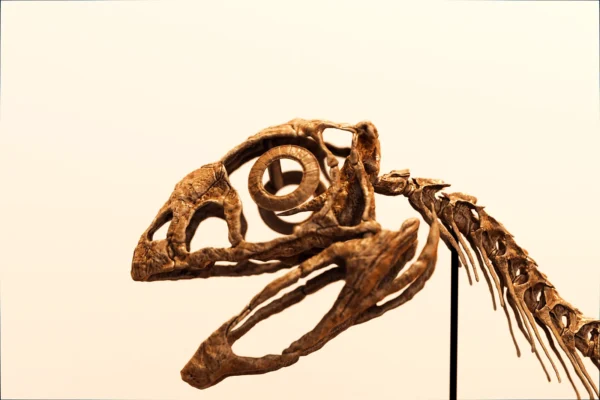
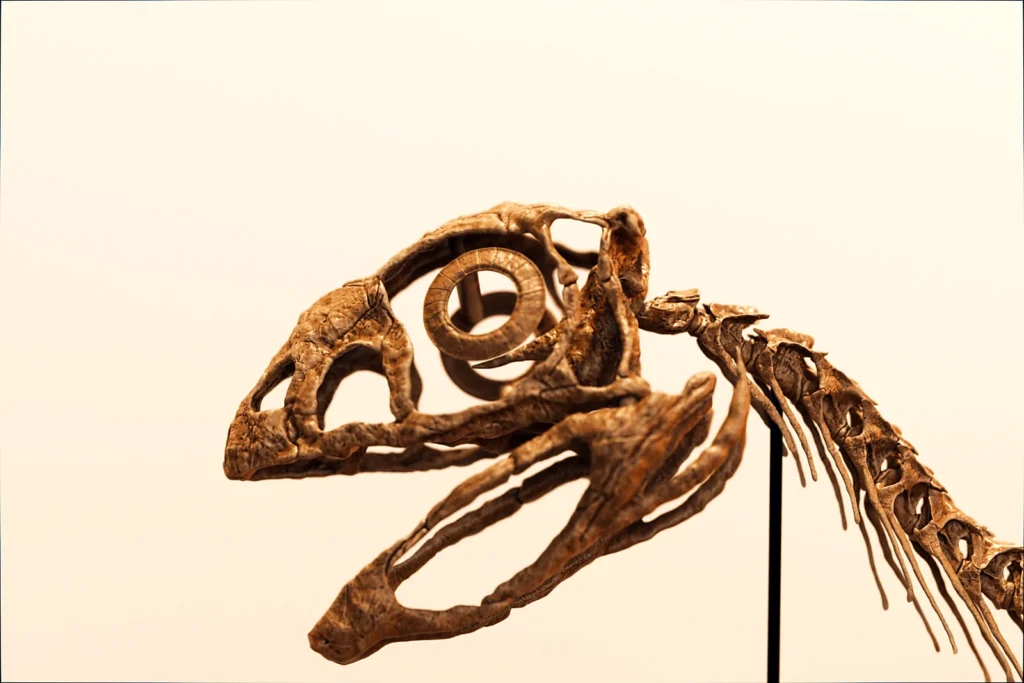
The skull is the interesting part. It has no teeth. The animal hatched with teeth and lost them as it grew, ending up with a short beak with sharp edges, on a body that otherwise looks like a small predatory theropod. Almost all ceratosaurs we know about were carnivores. This one was probably a herbivore, or an omnivore at least, and possibly for its whole life. The animal was published as the first edentulous ceratosaur from South America in Scientific Reports. In 2024 a new analysis moved it out of Noasauridae and placed it in its own family, Berthasauridae, as the sister group to the abelisauroids. The genus is named after Bertha Lutz, a Brazilian zoologist and campaigner for women’s rights. The species name is for Empress Maria Leopoldina, chosen voor the bicentenary of Brazilian independence. It lived in a sandy, desert-like environment alongside the pterosaurs Caiuajara, Keresdrakon and Torukjara. The age of the Goio-Erê Formation is still debated. The team that described it argued for the Aptian–Albian; other researchers have suggested a younger date.
I wrote up what the fossil actually preserves and what I had to reconstruct, including why the 2021 description and the 2025 restudy disagree about the teeth.
What’s in the download
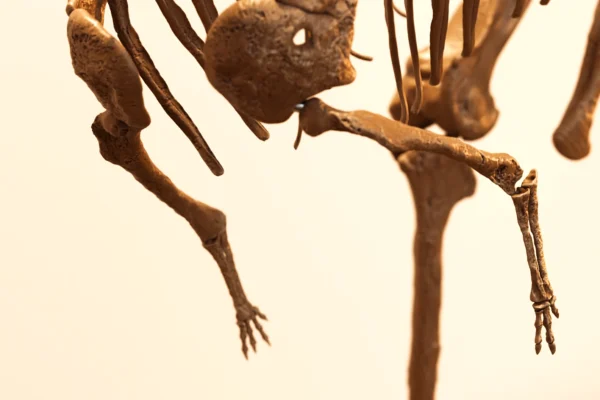
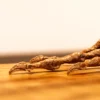
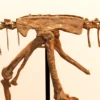
The download holds the complete set of STL parts and the assembly manual together, so everything you need is in one place. This is a life-size skeleton of the holotype specimen, MN 7821-V, built in Blender from the published description and from comparison with related ceratosaurs. Where the fossil is incomplete the reconstruction follows the closest relatives with good material. The mount follows museum practice. A single steel rod runs through the pelvis and carries the animal. A second, thinner rod supports the skull, so the weight of the head does not hang on the neck joint.
- 870 mm long (34.3 in) from snout to tail tip, 386 mm tall (15.2 in) above the base
- 1:1 scale, life size for the described specimen
- 19 STL files in seven folders: skull, neck, ribcage, forelimbs, pelvis, hindlimbs, tail
- Binary STL in millimetres, watertight. Each part is centred on the origin with its lowest point at Z = 0, so it drops onto the plate when you import it. Import at 100%, no rescaling needed.
- A 22-page assembly manual in PDF, with a render for every step, the drilling positions for the base, and the full list of steel rod lengths
Printer size you need
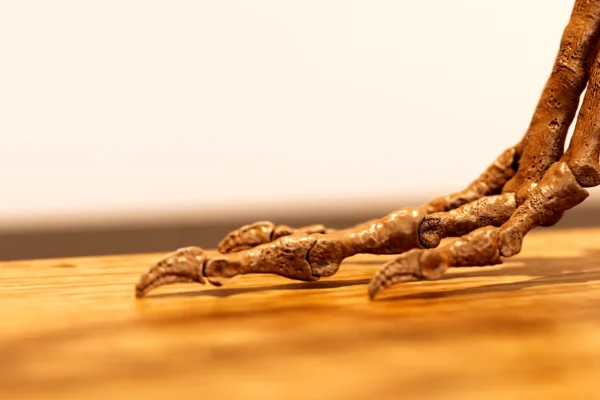
This dinosaur skeleton STL prints as 19 separate parts, so what matters is the largest one. That is the right foot, at 44.7 × 116.3 × 185.5 mm. Laid flat it uses 186 × 117 mm of plate and stands 45 mm high. Every other part is smaller in all three directions. FDM. The minimum is 186 × 134 × 80 mm if you lay everything flat. I would recommend 200 × 200 × 200 mm or more, so you can position parts for print quality rather than just to make them fit. An Ender, a Prusa MK series, a Bambu A1 or P1S will all handle the full set without trouble. Resin. Minimum 190 × 120 × 200 mm. In practice that means a Saturn-class printer, around 218 × 123 × 230 mm, or larger, which leaves room to tilt the parts. Please read this before you buy if you have a small resin printer. A Mars or Photon class machine, around 150 × 90 × 165 mm, will not fit the right foot in any orientation. The part is 185.5 mm long and the plate diagonal is only 175 mm. All the other parts fit fine on that size of printer, but you would need to cut that one foot in two and pin it, or have it printed elsewhere.
Printing this dinosaur skeleton STL
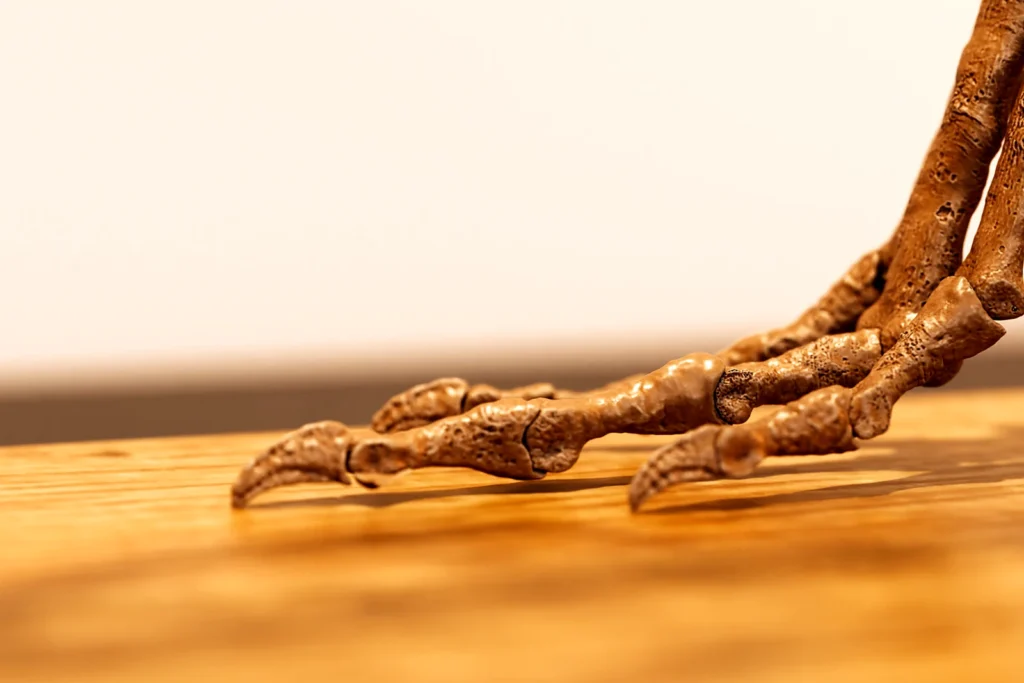
The ribs are thin, the neural spines are slender and the claws are about a millimetre across, so a fine nozzle and a slow print help far more than anything else. FDM. Use a 0.2 mm nozzle if you have one. A 0.4 will print the parts, but the rib cross-sections, the neural spines and the sclerotic rings lose a lot of definition. Layer height 0.08 to 0.12 mm, 4 walls (3 is fine at 0.2 mm), 15–20% gyroid infill, PLA or PLA+. Use tree supports rather than normal ones. Normal supports build a solid block around the ribcage and tear the surface when you remove them. Tree supports get in between the ribs and come off cleanly. Of all the settings, this is the one that makes the biggest difference. Slow the printer down: 30 to 40 mm/s on walls, 20 to 25 mm/s on small features. If you print fast you get stringing between the ribs and rounded claw tips. Budget for roughly double your usual print time. Resin. Layers of 0.03 to 0.05 mm, tilt the parts 20 to 30 degrees, light or medium supports on whichever face will be least visible. Do not hollow the parts. The bones are slender enough to print solid and a hollow rib snaps easily. Wash and cure everything properly before assembly, because glue does not bond well to resin that is still tacky, and every joint in this model is glued.
Assembly
The build order is pelvis, legs, feet, ribcage, forelimbs, neck, skull, and the tail last. Parts are glued, with steel pins at the joints that carry load. The manual takes it one bone at a time and shows a render at each step so you can see which part goes on next.
What to buy before you start
Round steel rod, stainless or mild, cut to length yourself: 8 mm × 346 mm for the main support, 2.5 mm × 366 mm for the skull support, and 4.5 mm and 2.5 mm pins between 2 and 40 mm long. The manual lists every piece with the joint it belongs to. For the base, a hardwood board of about 182 × 836 × 25 mm suits the model well. The manual gives both drilling positions and a dimensioned diagram, so you can have it cut and drilled while the parts are printing. If this one interests you, my Suchomimus and Quetzalcoatlus skeletons are built the same way.
Licence
Copyright Nova Studios. This dinosaur skeleton STL is sold for personal use only. You can print it for yourself as often as you like. You may not resell or share the files, sell printed copies, or print it for other people as a service. Commercial licences are available on request.
You must be logged in to post a review.


Reviews
There are no reviews yet.