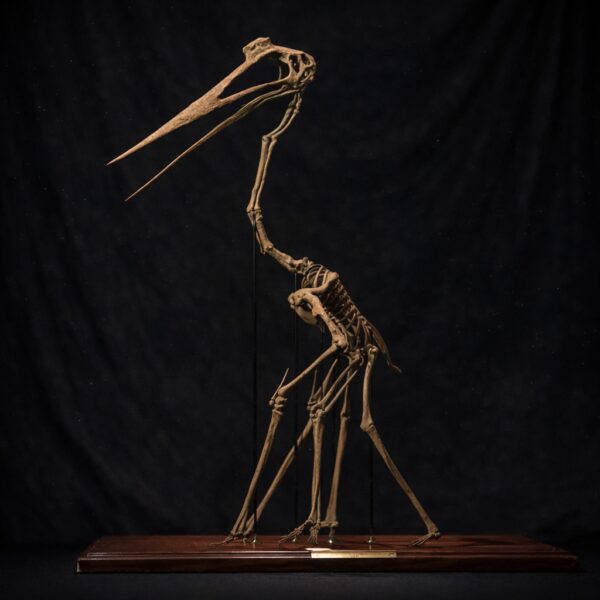
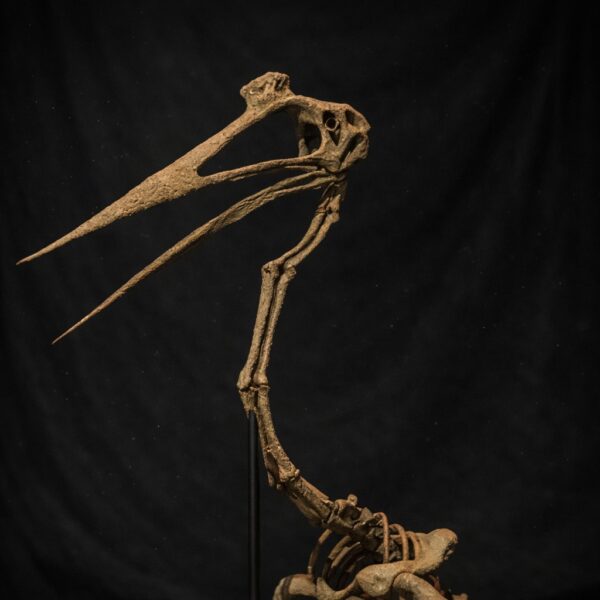
The Quetzalcoatlus skeleton STL file from Nova Studios offers a scientifically accurate digital model of the largest known flying reptile. This giant pterosaur lived during the Late Cretaceous period, approximately 68 to 66 million years ago, in what is now North America. As a prehistoric flying animal STL designed specifically for resin 3D printing, it allows enthusiasts and researchers to create detailed physical replicas of this remarkable creature’s anatomy.
About Quetzalcoatlus
Quetzalcoatlus northropi was first described by paleontologist Douglas A. Lawson in 1975, based on fossil remains discovered in the Javelina Formation of Texas. This giant pterosaur represents one of the largest flying animals to have ever lived, with an estimated wingspan reaching up to 10–11 meters. Its skeletal anatomy reveals elongated wing metacarpals and lightweight hollow bones adapted for powered flight, yet it also had robust limb bones suggesting it was capable of efficient terrestrial locomotion.
Quetzalcoatlus inhabited the Late Maastrichtian stage of the Late Cretaceous, roughly 68 to 66 million years ago. It likely occupied a niche as a scavenger or opportunistic predator, possibly feeding on small vertebrates or carrion across the coastal plains and inland environments of North America. The Javelina Formation where its fossils were found preserves a diverse ecosystem, providing context for this giant pterosaur’s paleoecology.
Model Details
This Quetzalcoatlus skeleton STL file includes a complete digital reconstruction of the articulated skeleton, featuring accurately modeled skull, vertebrae, wing elements, pelvis, and limb bones. The model is segmented into multiple parts optimized for resin 3D printing, facilitating detailed assembly and minimizing print failures. The skeletal proportions adhere closely to published measurements, based on Lawson’s original description and subsequent research.
Compared to generic pterosaur 3D models, this file prioritizes anatomical precision, enabling users to produce museum-quality 3D prints that reflect current paleontological understanding. The final assembled model spans approximately 40 cm in wingspan at 1:25 scale, making it suitable for display and study.
Printing Guide
For best results with this giant flying reptile skeleton file, use a resin printer set to a layer height of 0.05 mm or finer to capture delicate bone features. Orient wing elements flat or slightly angled to reduce support material on thin structures. Use moderate-density supports placed selectively under overhangs, particularly beneath the elongated wing metacarpals and jaw elements. Post-process with careful isopropyl alcohol rinses and UV curing to preserve fine details without warping. Assemble parts using cyanoacrylate glue, taking care to align joints accurately for anatomical correctness.
Frequently Asked Questions
Is this Quetzalcoatlus skeleton STL file suitable for resin 3D printers only?
Yes, the model is optimized for resin 3D printing to capture the fine anatomical details of the skeleton. While it can be printed on other technologies, resin printers provide the best resolution and surface finish for this file.
What scale is the Quetzalcoatlus 3D print designed for?
The digital model is designed at approximately 1:25 scale, resulting in a wingspan around 40 cm when printed. The file can be resized, but this scale balances detail and printability.
Can I use this file commercially or sell printed models?
No. This Quetzalcoatlus skeleton STL is for personal use only. Commercial use and sales of printed models are prohibited unless you are a licensed vendor authorized by Nova Studios.
How accurate is this pterosaur 3D model compared to fossil specimens?
The model is based on the original fossils described by Lawson (1975) and updated with current paleontological research. It reflects known skeletal anatomy and proportions, making it one of the most accurate digital Quetzalcoatlus skeletons available.
Is assembly required after printing?
Yes, the model is provided in multiple parts for practical printing. Users will need to carefully assemble the skeleton post-printing using adhesive, following included reference images to ensure correct anatomical alignment.





Reviews
There are no reviews yet.