 NOVA STUDIOS



- About Lystrosaurus
- What is in the Lystrosaurus skeleton STL download
- Printer size you need
- Printing the Lystrosaurus skeleton STL
- Assembly and the base
- Questions people ask
- Licence
About Lystrosaurus
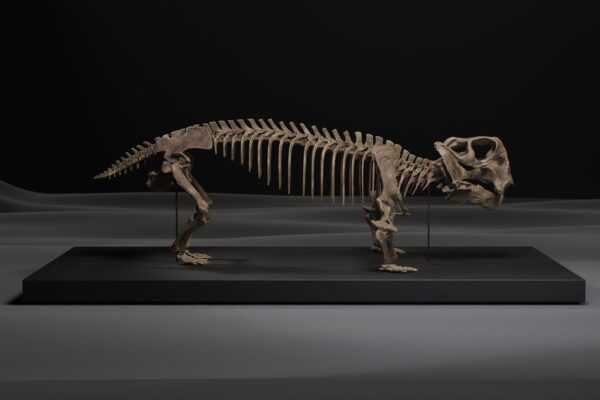
This Lystrosaurus skeleton STL builds my life-size reconstruction of Lystrosaurus murrayi, the tusked plant-eater that came through the worst mass extinction on Earth. It stands on all four legs on its base, about 978 mm from the tip of the snout to the end of the tail and 333 mm tall.
Lystrosaurus is a dicynodont, one of the plant-eating relatives of the mammals. It had a short, deep skull, a horny beak in place of front teeth and two tusks in the upper jaw. Edward Drinker Cope named the genus in 1870. Thomas Henry Huxley had already described this species in 1859, as Dicynodon murrayi, from a fossil found near Colesberg in South Africa.
About 252 million years ago, at the end of the Permian, most life on land and in the sea died out. Lystrosaurus made it through, and in the earliest Triassic it became by far the most common land animal. In parts of the Karoo Basin almost every fossil found is a Lystrosaurus. L. murrayi is known from the Karoo and from India. The Wikipedia page on Lystrosaurus gives a short overview.

I built the Lystrosaurus skeleton STL in Blender at life size. The stance follows Sanghamitra Ray’s work on how dicynodonts held their limbs: the forelimbs reach out to the side and the hind limbs stand closer under the body. As far as I know it is the first complete Lystrosaurus skeleton made for 3D printing. Where the fossils leave a question open, so does the model, and the manual lists the sources I used.
What is in the Lystrosaurus skeleton STL download
- 18 STL parts: the skull and the lower jaw, the neck, the ribcage in three sections, the pelvis with the sacrum, the tail, the shoulder girdle in one piece, the two forelimbs with their hands, the two femora, the lower legs and the two hind feet
- About 978 mm from the snout to the tip of the tail, 464 mm across the forelimbs and 333 mm tall above the board
- Holes for the steel already in the parts, 4.2 mm for the 4 mm pins and 8.2 mm for the two 8 mm rods, and printed pegs at the hips and the shoulders
- A 22-page assembly manual (PDF) with a render for every step, the cut lengths for the steel and the hole positions for the base
- Files in millimetres, ready to print at 100 %

Printer size you need
The Lystrosaurus skeleton STL is made for FDM printing on a standard FDM printer and for the larger resin printers. It prints in parts, so your printer only has to fit the biggest one. That is the shoulder girdle, at 218 mm along its longest axis.
On FDM every part fits a 220 × 220 mm bed, the shoulder girdle only just, so a 250 mm class machine gives you room to turn it. The ribcage sections and the skull are tall rather than long: the middle section of the ribcage needs about 165 mm of build height.
On resin, use a 14-inch class printer or bigger. The skull, the pelvis, the neck and the three ribcage sections are too deep for a 10-inch printer in any orientation. The limbs, the feet, the tail and the lower jaw do fit a 10-inch printer.
Printing the Lystrosaurus skeleton STL
The Lystrosaurus skeleton STL comes without supports. That is on purpose: where supports go depends on your printer, your material and how you turn each part, so that call is yours. Keep them out of the holes for the steel and the peg sockets, because a support inside a hole closes it.
The skull, the pelvis and the three ribcage sections are big, solid parts. On resin, hollow them in your slicer with 2.5 to 3 mm walls and drain holes, use a 0.03 to 0.05 mm layer height and tilt the parts 20 to 30 degrees. On FDM, a 0.4 mm nozzle at 0.08 to 0.16 mm layers works well with tree supports, four walls and 15 to 20 % gyroid infill. A 0.2 mm nozzle keeps the claws and the toes sharp.
The files are dense, several million triangles for the bigger parts. Give your slicer time and load the parts one at a time if it struggles. Print the pelvis and the three ribcage sections first, because they carry the whole animal.

Assembly and the base
The Lystrosaurus skeleton STL is built from the base up, in a fixed order. The steel goes into the board first and the hind feet slide down over their pins. The pelvis and the hind legs are joined on the bench and go onto the base together, then the forelimbs with the shoulder girdle. The ribcage follows from the hips forward, then the neck and the tail, and the skull goes on last.
Steel holds it together. Sixteen 4 mm pins join the parts, and two 8 mm rods come up out of the base: one into the pelvis, and one up through the board and the shoulder girdle into the neck. The thigh bones and the upper arm bones plug into the hips and the shoulders on square pegs printed on the bones. In my photos it stands on a dark board of 1050 × 550 mm. The board and the steel are not included.
You supply one metre of 4 mm steel rod and one metre of 8 mm rod, which leaves margin for a mis-cut, two-part epoxy for the joints that carry weight, and medium CA glue for the fibula and small touch-ups. Building it takes a weekend, most of it waiting for the epoxy. Dry-fit every joint before you glue it.
If you like animals from the Permian and the Triassic, the Diplocaulus skeleton is an amphibian from the Early Permian, and the rest of my 3D printed skeleton files are on the STL page.

Questions people ask
Can I print the Lystrosaurus skeleton STL smaller or bigger?
Yes, as long as you scale every part by the same factor. If you print it smaller, the holes for the steel get smaller with it, so the rods have to get thinner too. At 50 % the 4.2 mm holes become 2.1 mm and the 8.2 mm holes 4.1 mm: use 2 mm and 4 mm rod and halve every cut length in the manual. At any other scale, multiply the rod diameters and the lengths by the same factor and round the diameter down.
Will it fit my 10-inch resin printer?
Partly. The limbs, the feet, the tail and the lower jaw fit. The skull, the pelvis, the neck and the three ribcage sections are too deep, so for those you need a 14-inch class resin printer or an FDM printer.
Why does the Lystrosaurus skeleton STL need steel?
The skeleton is almost a metre long and stands on four slender legs. The two 8 mm rods carry the trunk down into the base and the 4 mm pins keep the joints and the backbone in line, so the printed legs do not carry the weight on their own.
Is the skull of the Lystrosaurus skeleton STL one piece?
Yes. The skull of the Lystrosaurus skeleton STL prints as one part of about 197 × 154 × 153 mm. The lower jaw is a separate part and goes on with two 4 mm pins.
How big a board does the Lystrosaurus skeleton STL need?
The board in my photos and in the manual is 1050 × 550 mm and 30 mm thick, in solid wood or a good plywood. The skeleton comes to about 35 mm from both ends and about 40 mm from the long edges, so a smaller board will not hold it in this pose. The manual gives the positions of the six holes.
Which parts of the Lystrosaurus skeleton STL should I print first?
The pelvis and the three ribcage sections. They carry the whole animal, so check them before you print the limbs and the skull. They are also the parts to test the fit of a 4 mm pin in.
How do you paint a fossil skeleton like this?
A mid to dark brown base, a thin dark wash pulled into the crevices and a dry-brushed highlight on the ridges reads well on a fossil skeleton. Fill the seams sparingly where the bone has fine pits and cracks, so the texture stays open. Prime first, and keep the steel matt.
What file format is the Lystrosaurus skeleton STL?
STL, one file per part, in millimetres. Every file carries its part number in the name, so the files and the manual always match. They are dense meshes, so give your slicer time.

Licence
The Lystrosaurus skeleton STL is for personal use only. You can print it for yourself as often as you like. You may not resell or share the files, sell printed copies, or print it for other people as a service. Commercial licences are available on request. Instant digital download, nothing is shipped.


Reviews
There are no reviews yet.