
- About Pachycephalosaurus
- What is in the Pachycephalosaurus skull STL download
- Printer size you need
- Printing the Pachycephalosaurus skull STL
- Assembly and the stand
- Licence
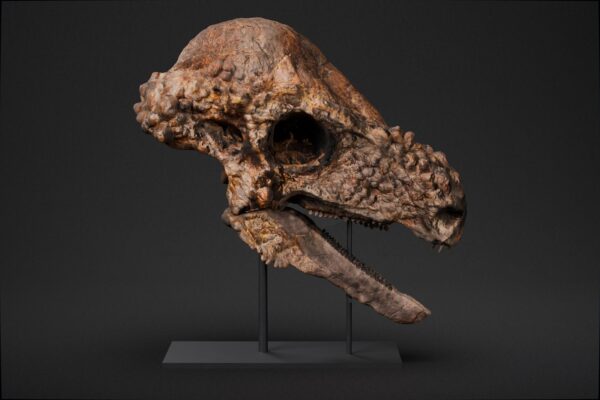
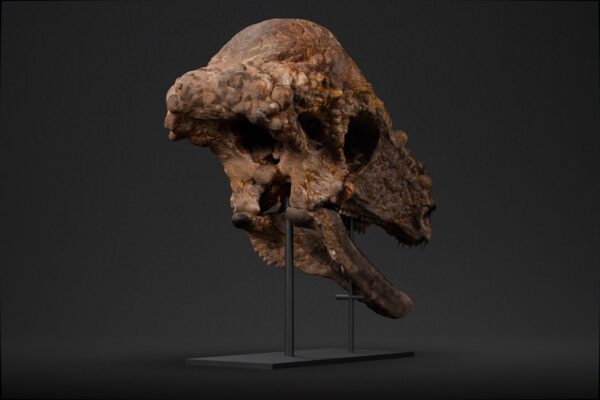
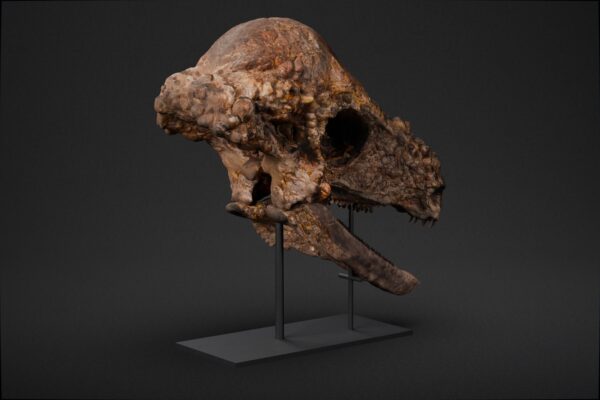
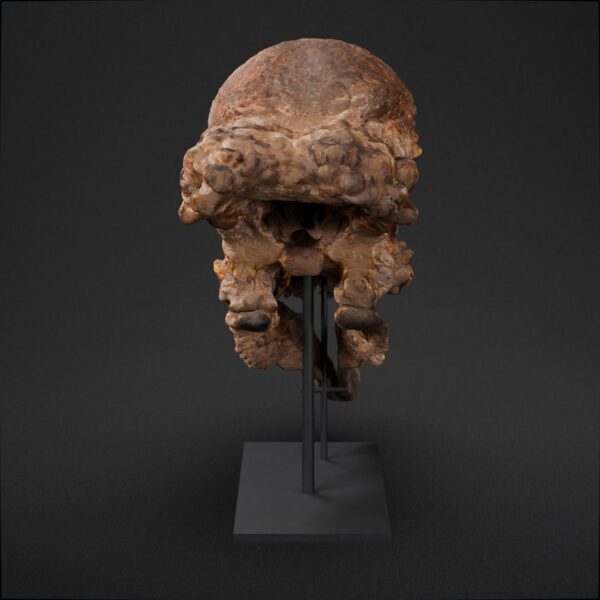
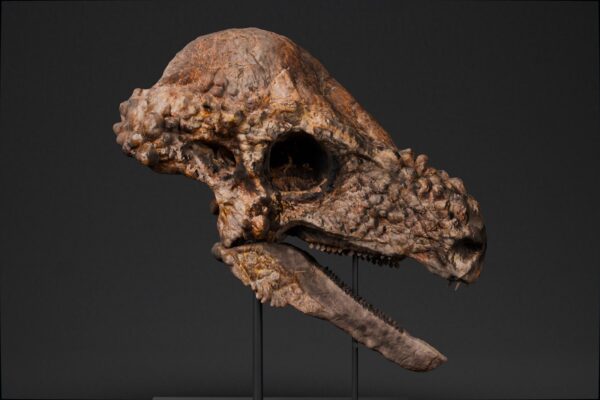
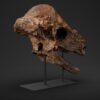
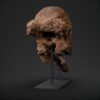
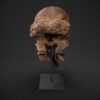
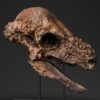
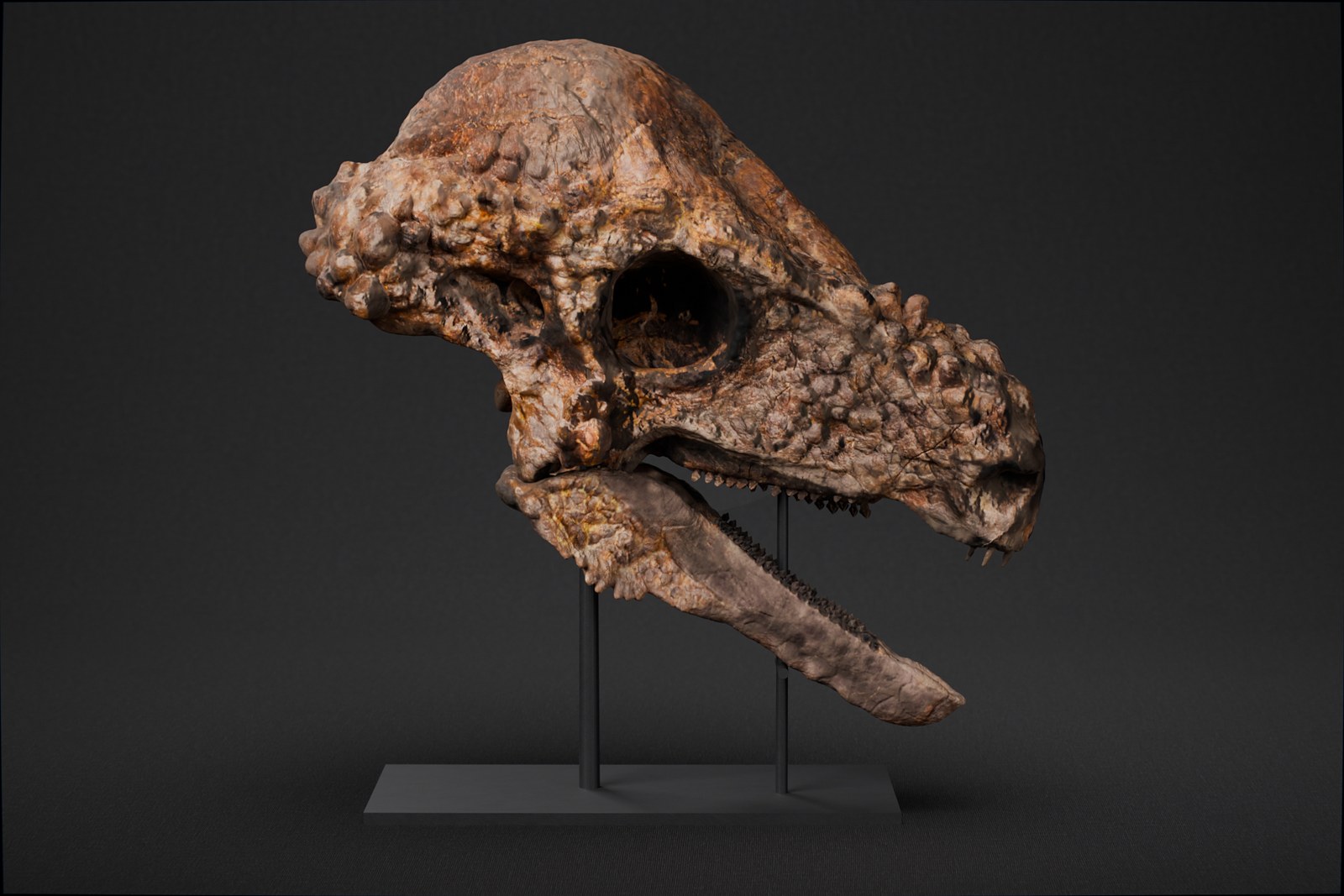
This Pachycephalosaurus skull STL is a life-size reconstruction of an adult Pachycephalosaurus wyomingensis, built from the skull Sotheby’s sold in New York in July 2025. I call him Jared. The name of the animal means thick-headed lizard, and after a few months with this skull on my screen I can confirm that it fits. He is 533 mm long from the back of the dome to the tip of the snout, posed with the jaw open, and he comes in sixteen parts that fit a standard FDM printer or a large resin machine.
About Pachycephalosaurus
Pachycephalosaurus lived at the very end of the Cretaceous, about 68 to 66 million years ago, in the Hell Creek ecosystem of Montana and the Dakotas, next to Tyrannosaurus, Triceratops and Edmontosaurus. It was a plant-eater of roughly four and a half metres, walking on two legs, with a small face, leaf-shaped cheek teeth and a few sharp fangs at the front of the upper jaw that nobody has fully explained.
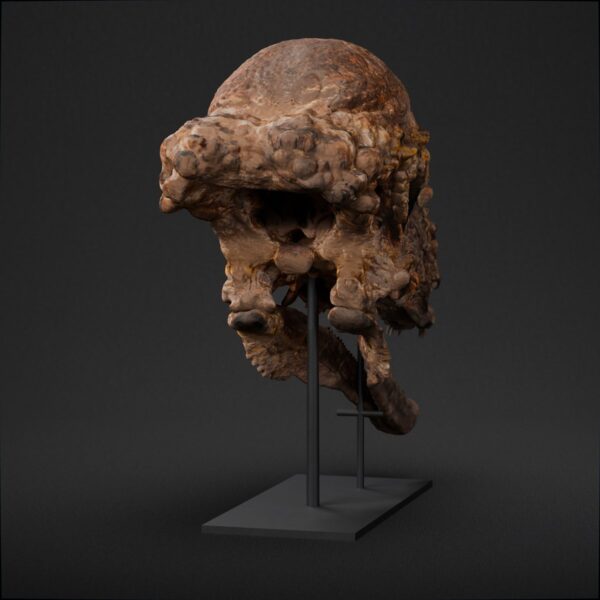
What everyone knows it for is the dome. In a grown animal the frontal and parietal bones fuse into a lump of solid bone up to 25 cm thick, ringed at the back with a row of knobs and short spikes.
For decades these animals were drawn ramming each other head-on. That is still argued about — combat, display, telling your own species apart, or all three — and the honest answer is that we do not know. The knobs are kept sharp on this model all the way to the finished surface, because they are the first thing anyone leans in to look at.
Complete Pachycephalosaurus skulls are rare. Fewer than twenty-five are known and most of those are domes with nothing attached. The specimen this Pachycephalosaurus skull STL is based on was excavated in 2024 in Perkins County, South Dakota, and offered at auction as a virtually complete skull with its teeth: thirty-two cranial bones, the atlas, both hyoids, two premaxillary fangs and two maxillary teeth, about 53 cm long.
The left side is largely original; parts of the right side and the lower jaws were restored. That is as good as this animal gets, and it was the reason to build a face for it instead of stacking one guess on another.
The model is my own sculpt, made in Blender from the published photographs of the specimen and from what the anatomy of the group demands. Nothing here is a scan. Where a photograph could not show me something, I worked from the literature and from related animals, so this is an interpretation — a careful one, but mine.
What is in the Pachycephalosaurus skull STL download
The Pachycephalosaurus skull STL download holds the complete set of parts and the assembly manual together, so everything you need is in one place.
- 533 mm long (21 in) from dome to snout, 525 mm tall on its plate — 1:1, life size for the specimen
- 16 STL files: the cranium in thirteen parts, the lower jaw in three
- The parts locate on 29 printed pegs that are part of the files — square, tapered, with the sockets already cut in the neighbouring part. No drilling for the skull itself.
- Two 4 mm steel pins carry the open jaw, and the sockets for a two-rod stand are in the model
- Files at 1:1 in millimetres, one closed shell per part. Import at 100%, no rescaling.
- A 20-page assembly manual in PDF: print settings, the eleven steps in order with a render for each, the peg and pin list, the stand with a dimensioned drawing of the plate, and notes on seams, primer and colour
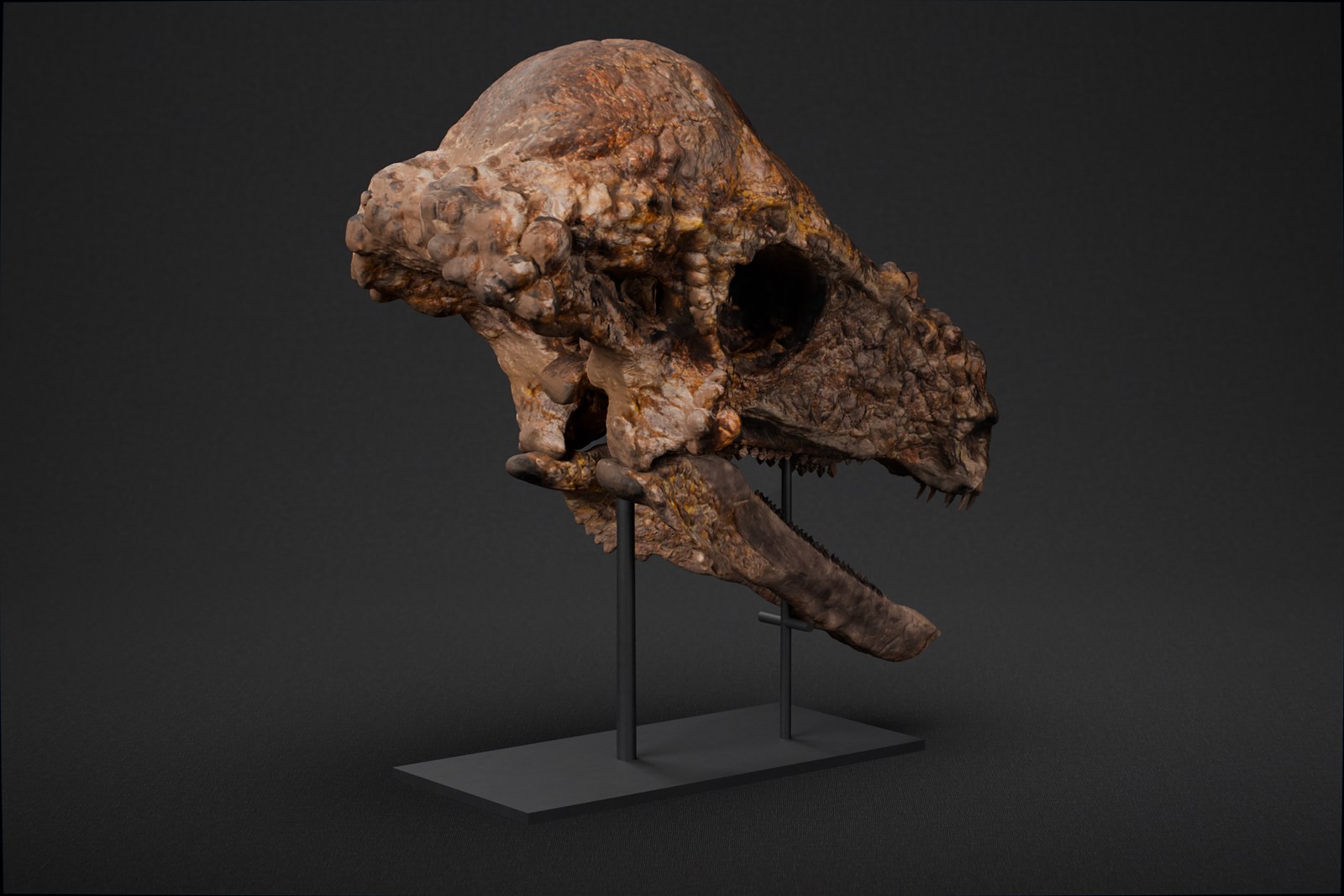
The skull is posed with the mouth open and stands on a 12 mm post and an 8 mm rod, the way the specimen was shown at auction. If you would rather mount it your own way, the sockets are easy to ignore.
Printer size you need
Sixteen parts in the Pachycephalosaurus skull STL, so what matters is the largest one. That is the right dome flank at 194 × 124 × 112 mm with its pegs, and everything else is smaller in at least one direction. Every part was cut so that its smallest dimension stays under 116 mm.
FDM. A standard 220 × 220 mm bed with 200 mm or more of height takes the whole set lying flat. On a 180 × 180 mm bed the two dome flanks have to stand on end, which they do without trouble at 194 mm tall. An Ender 3, a Prusa MK series, a Bambu A1 or P1S will all print the full set.
Resin. The parts were cut for an Anycubic Photon Mono M7 Pro, 223 × 126 × 230 mm, with 5 mm to spare on every side. Any printer of that class or larger will take them — a Saturn-class machine with a 219 × 123 mm plate fits every part as long as the two dome flanks are stood on their narrow side. A Mars or Photon class printer, around 150 × 90 mm, will not fit the larger parts in any orientation. Please check this before you buy if you have a small resin printer.
Printing the Pachycephalosaurus skull STL
The surface of this skull is the point: the knobs, the spikes and the fine bumps of fossil bone are all in the mesh, so the parts want a clean orientation and a slow print more than anything else. Put the flat cut faces toward the plate and tilt the part 15 to 20 degrees, so the supports land on the cut faces and nowhere else. The cut faces disappear inside the joints; the sculpted surface should never carry a support.
FDM. A 0.4 mm nozzle is fine for this model. Layer height 0.12 to 0.16 mm, three walls, 10 to 15% gyroid infill, PLA+ or PETG. Tree supports on the cut faces only. The pegs print as part of the piece: where a peg has to face the supports, put light supports on its tip and its two lower sides and nothing more. Slow the walls down to 30 to 40 mm/s for the node rows and the teeth.
Resin. Layers of 0.05 mm, 0.03 for the dome caps if you want the surface cracks crisp. Hollow every part to a 3.5 mm wall and put the drain holes in the cut faces, where they will be glued shut; solid, the set would cost twelve litres of resin, hollowed about 3.4.
Leave the peg sockets, the pin bores and the stand sockets solid — hollow around them, not through them. Use a tough or ABS-like resin rather than a standard brittle one, because the pegs carry the alignment of every joint and the jaw hangs on two pins. Wash, dry and cure fully before you glue anything.
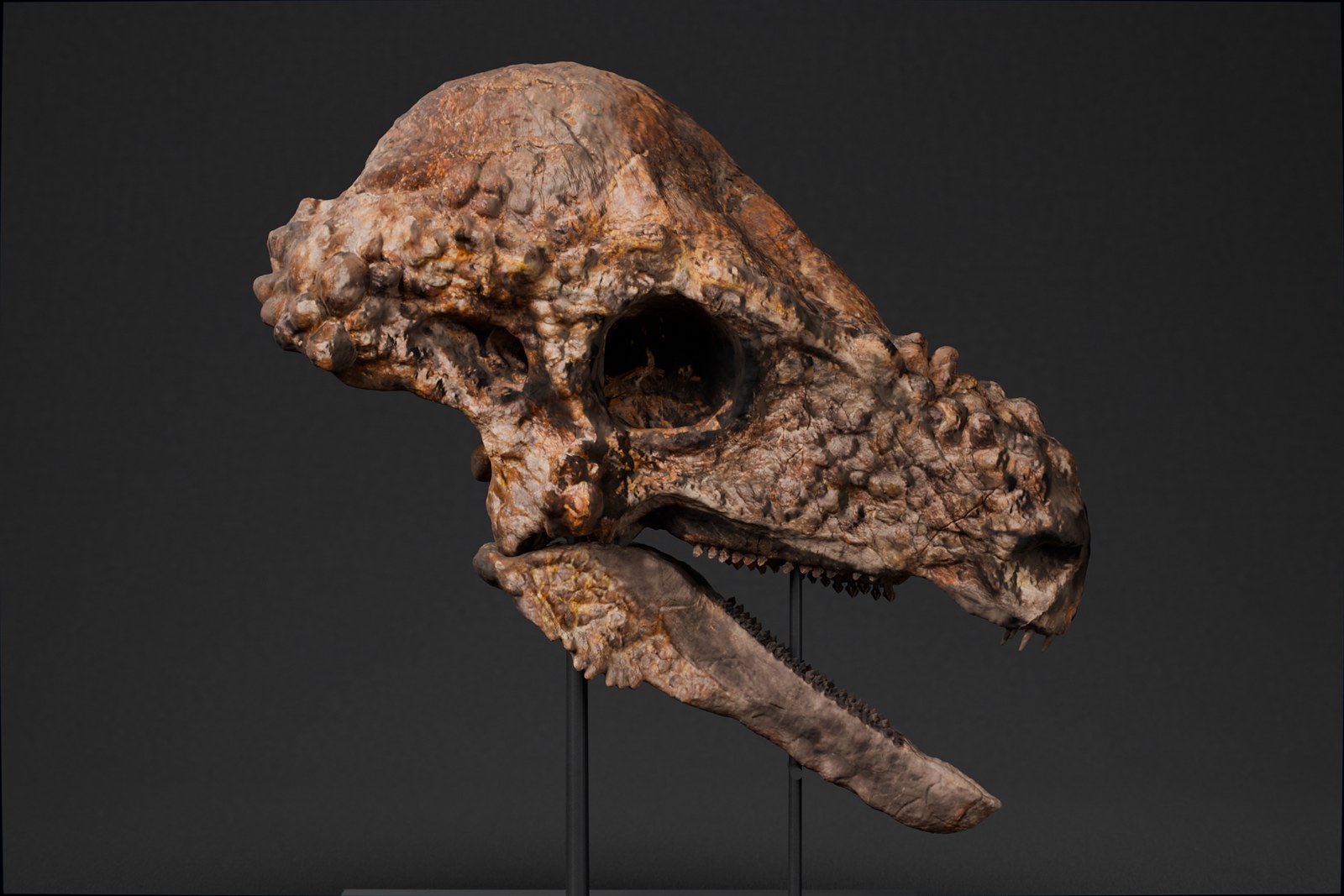
The pegs in this Pachycephalosaurus skull STL are 10 mm square and 12 mm long with 0.3 mm of clearance to their sockets. Try every peg in its socket before you glue: it should enter with light hand pressure and stop on the cut face. Where a socket prints slightly under, a few strokes of a needle file in the socket — never on the peg — fixes it.
Assembly and the stand
The Pachycephalosaurus skull STL goes together in eleven steps: the right half from the skull base up, then the left half beside it, the two halves joined on a single peg, the snout, and the jaw last. Every peg points along the direction the part is pushed on, so the parts only go together one way. Two-part epoxy on the pegs and the faces around them, thin cyanoacrylate along the long seams once they are closed. The manual shows a render at every step with the part being added in colour.
What to buy before you start. 100 mm of 4 mm steel rod for the two jaw pins. For the stand, a 12 mm rod of 285 mm, an 8 mm rod of 320 mm (265 for the upright, 55 for a cross-bar welded to it that holds the open jaw from below) and a steel plate of 360 × 170 × 10 mm, or a base of your own with that footprint.
The manual gives the two drilling positions and a dimensioned drawing, so you can have the plate cut and drilled while the parts are printing. Drill bits of 4.2, 8.3 and 12.3 mm to clear the bores by hand, epoxy, tape and a needle file are the rest of it.
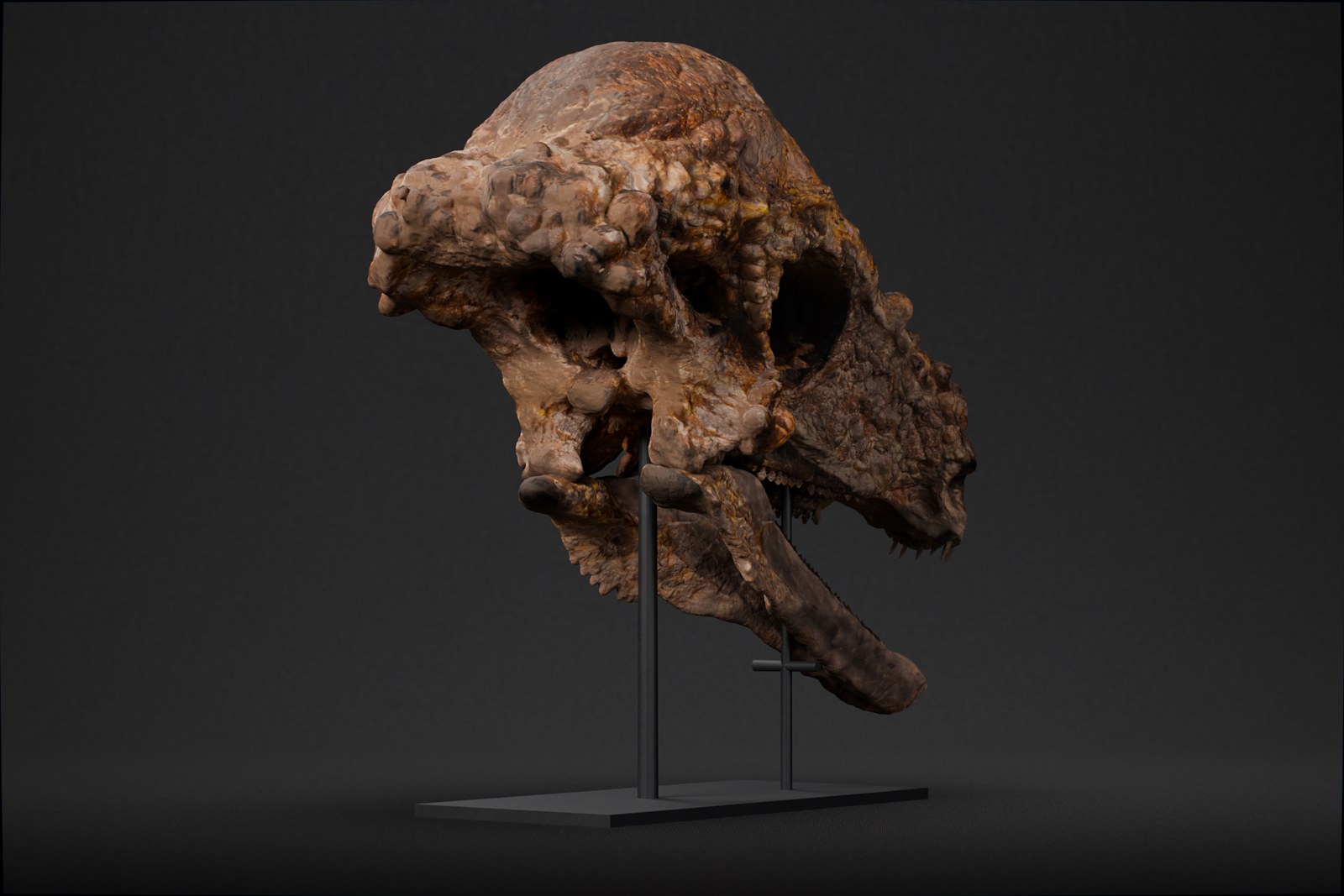
If a skull on a stand is what you are after, my Berthasaura and Bambiraptor skeletons are built and documented the same way, and the rest of the 3D printed dinosaur files are here.
Licence
Copyright Nova Studios. This Pachycephalosaurus skull STL is sold for personal use only. You can print it for yourself as often as you like. You may not resell or share the files, sell printed copies, or print it for other people as a service. Painted, finished copies of Jared are sold by the licensed vendors listed on the home page; commercial licences are available on request.
You must be logged in to post a review.


Reviews
There are no reviews yet.